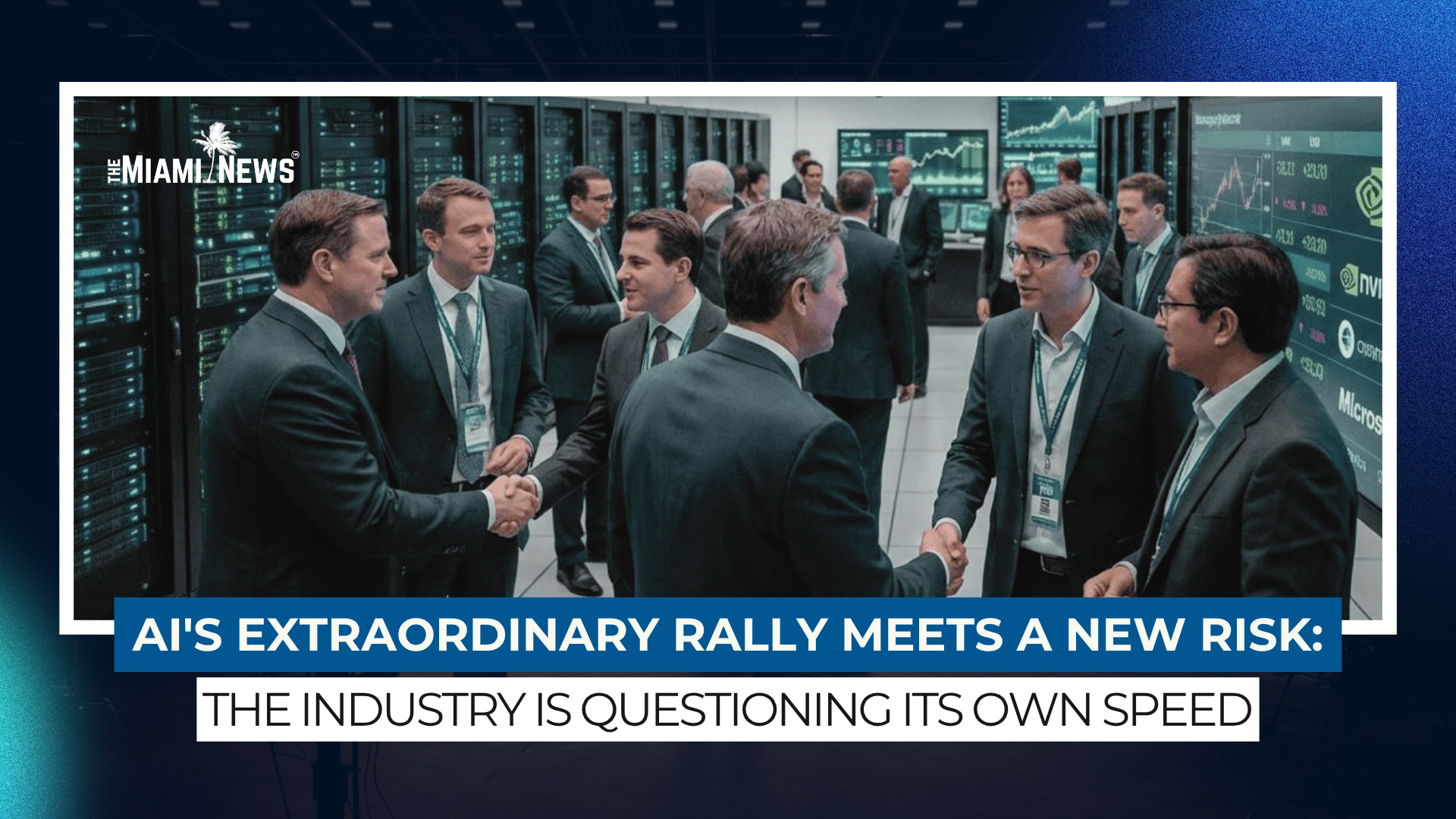
U.S. technology shares fell as concerns over artificial-intelligence development collided with $100-plus oil and a 10-year Treasury yield at 5%, testing Wall Street’s defining investment story.
NEW YORK — The artificial-intelligence boom has spent years convincing investors that faster is better: faster chips, faster models, faster data-center construction and faster deployment across the global economy.
On Monday, markets confronted the possibility that the next phase could require something different — restraint. The call for it came from inside the industry.
Anthropic chief executive Dario Amodei argued publicly that AI developers should slow the pace at which they improve model capabilities, in order to ensure the technology is safe. OpenAI’s Sam Altman agreed, saying the frontier needs to be paced.
Wall Street has spent three years pricing in the opposite. Semiconductor stocks sold off hard, with the Philadelphia Semiconductor Index falling roughly 5%.
A Three-Sided Squeeze
The AI warning did not arrive alone.
Escalating Middle East hostilities sent crude to four-month highs. Houthi drone attacks on Saudi Arabia and a pipeline shutdown pushed Brent crude to about $107.30 a barrel, up roughly 2.6%, while West Texas Intermediate settled near $102.30.
Rising energy prices revived inflation concerns. The yield on the benchmark 10-year Treasury climbed to 4.999% — essentially 5%, and its highest level since October 2023.
Investors were also bracing for this week’s Federal Reserve meeting, where markets priced in roughly an 85% probability of a rate hike following hotter-than-expected inflation data.
The major indexes finished lower. The S&P 500 fell 0.48% to 7,619.95. The Dow Jones Industrial Average declined 0.29% to 52,421.28, while the Nasdaq Composite dropped 0.56% to 26,186.41. The Russell 2000 slipped 0.25% to 2,896.71.
Those modest index losses understated the forces converging beneath them.
For investors, higher long-term interest rates matter enormously here. They reduce the present value of profits expected far into the future, which is precisely the sort of earnings expectation supporting many high-growth technology stocks.
Two Questions at Once
The market is therefore confronting two problems simultaneously.
The first is financial. How expensive can AI companies become when investors can earn 5% from benchmark government debt?
The second is more fundamental. What happens if the companies and scientists developing the world’s most powerful AI systems conclude that technological capability is advancing faster than society’s ability to manage it?
That second question explains why a pair of essays moved markets at all.
Artificial intelligence has already become far more than a Silicon Valley investment theme. Data centers are transforming electricity demand. Semiconductor supply chains have become geopolitical assets. Governments are debating regulation, copyright, national security and employment. Companies across finance, medicine, logistics, advertising, law and media are reorganizing workflows around increasingly capable models.
At that scale, even a discussion of slowing development registers worldwide.
A More Demanding Phase
Wall Street’s enthusiasm has nevertheless remained powerful. The major indexes are still well ahead for 2026, and Monday’s declines did not approach the scale of a genuine repricing.
Investors have hardly abandoned risk.
Instead, the market may be entering a more demanding stage of the AI cycle — one in which enormous capital spending must increasingly translate into measurable profits.
The implications extend to South Florida.
Miami has spent much of the decade positioning itself as an alternative technology and financial center, attracting venture investors, cryptocurrency businesses, entrepreneurs and financial firms from traditional hubs such as New York and California.
An AI investment slowdown would not remain confined to Silicon Valley. Venture financing, cloud-computing costs, startup valuations and corporate technology budgets would all feel the consequences.
Meanwhile a more disciplined AI market could benefit companies capable of demonstrating genuine productivity improvements, rather than simply attaching artificial intelligence to an existing business model.
That distinction increasingly matters.
Inevitable Is Not the Same as Profitable
Every transformative technology produces a period when expectations run ahead of economics.
The internet survived the dot-com crash. Railroads transformed America despite waves of bankruptcies. Electrification created enormous wealth even as individual companies disappeared.
Artificial intelligence may prove equally consequential while still producing painful corrections along the way.
Monday’s market action was hardly a crash. But it offered investors a reminder that technological inevitability does not guarantee financial inevitability.
AI may continue transforming the world.
The harder question is which companies will make money doing it — and how much investors should pay today for profits that may arrive years from now.