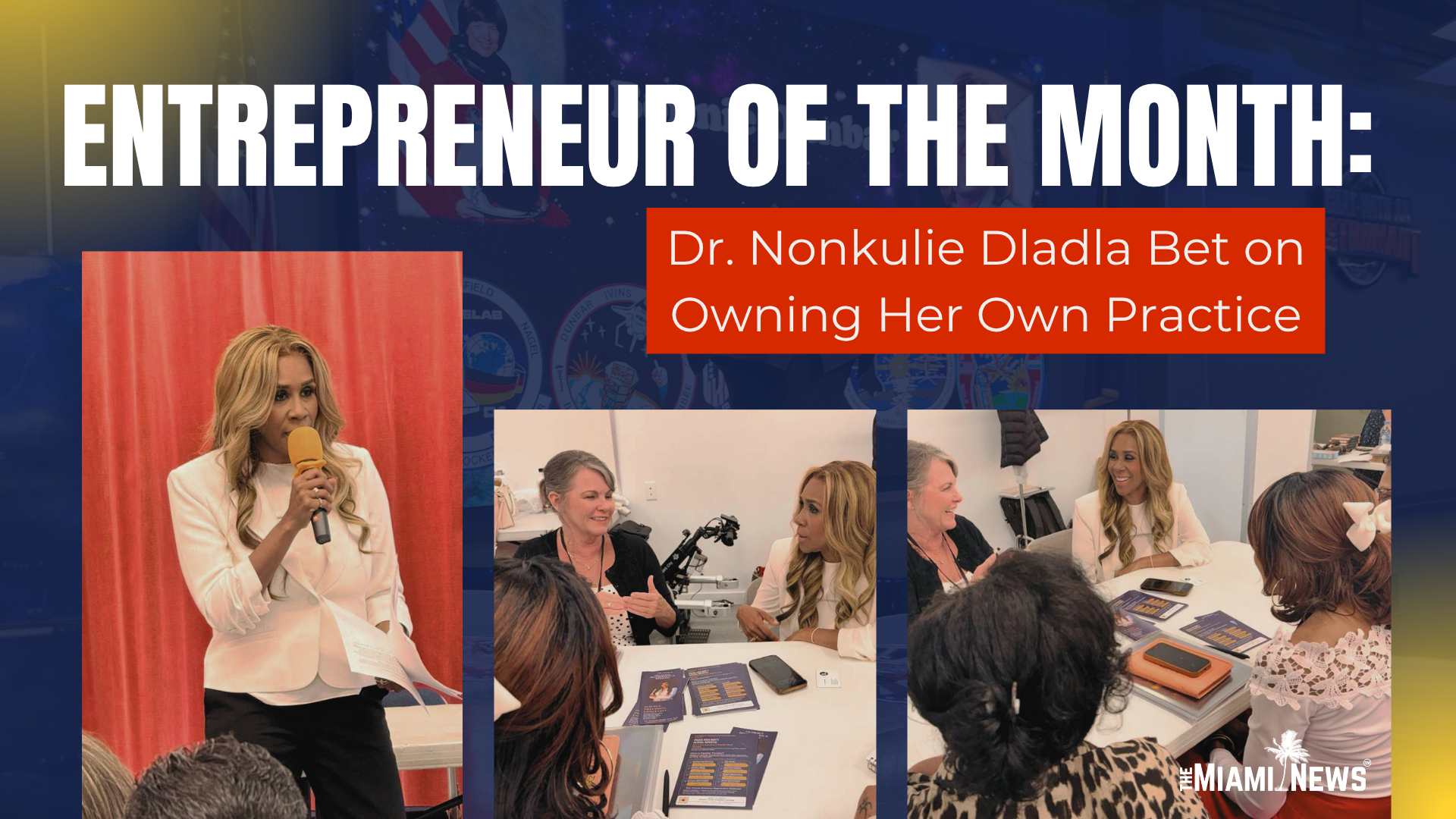
The Miami News Entrepreneur of the Month for September: Dr. Nonkulie Dladla built an independent medical practice in Manhattan at the exact moment American physicians were giving theirs up.
NEW YORK — Dr. Nonkulie Dladla trained inside the institutions that define American medicine. She took her M.D. at Weill Cornell Medical College. She added a master’s in clinical research and epidemiology from Cornell’s graduate school, then completed her internal medicine residency at NewYork-Presbyterian Brooklyn Methodist Hospital. Twenty years of clinical practice followed.
Then she did the thing the data says physicians have stopped doing. She opened her own shop.
Dladla is founder and medical director of the Gramercy Park Regenerative and Integrative Medicine Center in Manhattan. The practice is built around root-cause diagnostics rather than symptom management. The Miami News names her Entrepreneur of the Month for September — not only for the medicine, but for the decision to own the practice at a moment when almost nobody does.
The Trend She Ran Against
The numbers here are not ambiguous.
According to American Medical Association data published in June 2025, just over 42% of U.S. physicians now work in private practice. That figure has fallen 18 percentage points since 2012. Meanwhile more than a third of doctors work in hospital-owned practices, and nearly 7% work for firms owned by private equity.
The ownership picture is starker still. In 2012, 53.2% of physicians held an ownership stake in their practice. By 2024 that had dropped to 35.4%.
Furthermore, for the first time in the history of the AMA’s survey, fewer than half of American physicians worked in small practices of ten doctors or fewer. In the early 1980s, roughly 80% did.
That is the backdrop against which an independent, physician-owned practice in Manhattan should be understood. It is not the default path. Increasingly, it is the exception.
What the Practice Actually Does
Gramercy Park Regenerative and Integrative Medicine sits at the intersection of conventional internal medicine and a set of newer therapeutic approaches.
The center offers bioidentical hormone replacement therapy for men and women, peptide protocols and exosome-based regenerative treatments. It also provides IV nutrition, metabolic restoration and weight-health work, and treatment for chronic fatigue and hormonal imbalance. It operates as a concierge model, serving patients across the New York–Newark–Bridgeport metropolitan area in person and by virtual consultation.
Underneath the service list is a methodological argument. Dladla’s stated approach pairs advanced diagnostics with individualized, data-informed care. Rather than starting from a patient’s complaint, she starts from what she describes as the deeper question behind it.
Her epidemiology training is relevant here. Integrative and functional medicine attracts justified skepticism from parts of the medical establishment. Much of that criticism is aimed at practitioners who arrive without rigorous research grounding. By contrast, a physician holding a master’s in clinical research and epidemiology alongside board certification in internal medicine is operating from a different starting position.
A patient identified as T. Reid, quoted on the practice’s site, put the appeal plainly: “The testing revealed things I’d been struggling with for years.”
The Business Behind the Medicine
Concierge practice is often written about as a luxury product. That framing misses what is actually driving physicians toward it.
Consolidation has changed the terms of clinical work. Hospital and corporate ownership brings scheduling quotas, coding pressure and appointment lengths set by administrators rather than clinicians. The fifteen-minute visit is not a medical judgment. It is a financial one.
An independent practice trades the security of employment for control over that variable. For a physician whose method depends on extensive diagnostics and long conversations, the trade is not really optional. The medicine she wants to practice does not fit inside a standard appointment.
Still, the entrepreneurial risk is real. Independent practices carry their own overhead, malpractice exposure, staffing, technology and compliance burdens, with no health system absorbing any of it. That is precisely why the ownership figures have collapsed.
Why It Matters Beyond One Practice
Medicine is not the only field where consolidation has stripped practitioners of ownership. It may, however, be the one where the consequences land most directly on ordinary people.
When the share of physicians who own their practice falls by nearly eighteen points in a dozen years, certain decisions migrate away from the exam room. How long a visit lasts. Which tests get ordered. What counts as an acceptable outcome. Those choices end up in operating budgets instead.
Independent physicians are, in that sense, a structural check. Not because they are better doctors, but because someone has to be able to make a clinical decision that a spreadsheet would veto.
Dladla built one of the practices still in that column. In September 2026, with the trend running hard the other way, that is worth naming.
The Miami News | Quick Take
- Entrepreneur of the Month: Dr. Nonkulie Dladla, M.D.
- Practice: Gramercy Park Regenerative and Integrative Medicine Center, New York City
- Role: Founder and Medical Director
- Board certification: Internal Medicine
- Training: M.D., Weill Cornell Medical College; M.S. in Clinical Research and Epidemiology, Cornell University Graduate School; residency at NewYork-Presbyterian Brooklyn Methodist Hospital
- Experience: 20+ years in clinical internal medicine
- Focus: Integrative and functional medicine, bioregulatory systems, BHRT, peptide and exosome protocols, metabolic restoration, chronic fatigue
- Model: Concierge; in-person and virtual across the New York–Newark–Bridgeport metro
- The context: Physician practice ownership fell from 53.2% in 2012 to 35.4% in 2024, per the AMA
More from The Miami News: Sir Michael Fomkin and the Business of Getting People in the Room