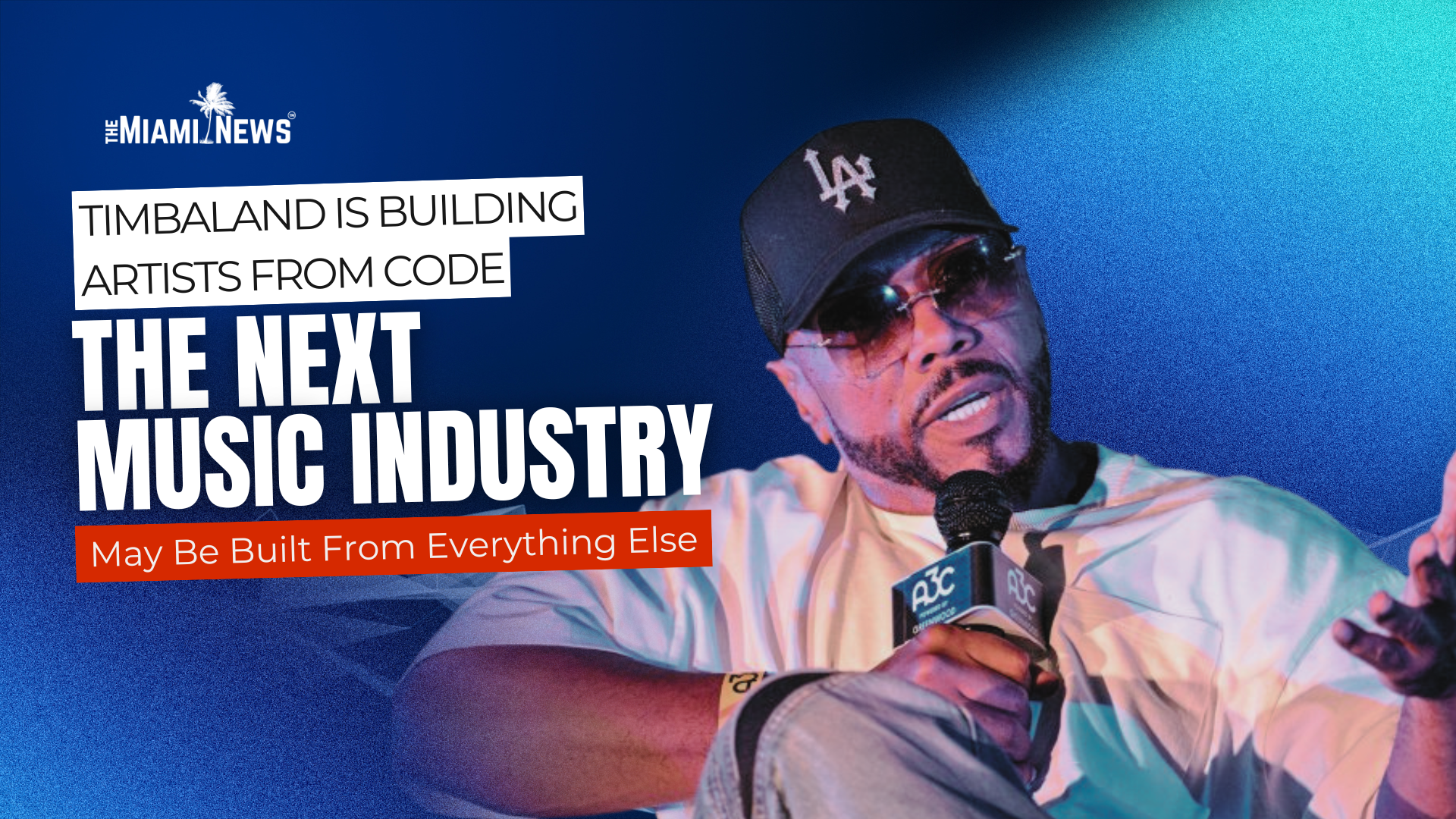
The Grammy-winning producer’s Stage Zero experiment points toward a future of autonomous artists, licensed digital voices, adaptive songs and entertainment that changes in real time. For VIP Ignite Live, that future could become the event itself.
For decades, technological revolutions in music followed a familiar pattern: musicians got a new instrument.
The synthesizer expanded the palette. Sampling turned recordings into raw material. Auto-Tune transformed the voice. Streaming rebuilt distribution.
Artificial intelligence may be fundamentally different.
It isn’t merely becoming another instrument inside the studio. It is beginning to participate in virtually every layer of the music business — from composition and production to artist identity, intellectual property, fan interaction, visual storytelling and potentially the live performance itself.
Producer Timbaland provided an early glimpse of that future when he launched Stage Zero, an AI-focused entertainment company co-founded with producer Rocky Mudaliar and entrepreneur and AI music strategist Zayd Portillo. Its first announced artist, TaTa, was created using technology from generative-music company Suno. Timbaland called the emerging category “A-Pop,” or artificial pop.
But the more important idea wasn’t the virtual singer.
It was the system behind her.
“I’m not just producing tracks anymore,” Timbaland said when announcing the company. “I’m producing systems, stories, and stars from scratch.”
That sentence may prove considerably more consequential than another AI-generated song.
Because the future of music may not simply be AI making music.
It may be music becoming software.
From Recording Songs to Building Worlds
Stage Zero describes itself today as operating at the intersection of music, storytelling and innovation, developing artists, intellectual property and AI-powered creative tools. It also emphasizes documentation, attribution, contractual consent and ownership — issues that have quickly become central to the AI music economy.
TaTa has meanwhile moved beyond an experiment. In March 2026, Pacific Music Group signed TaTa Taktumi, describing the project as a “part human” AI artist.
The distinction matters.
The most interesting AI entertainment may ultimately exist somewhere between human and machine rather than replacing one with the other.
Imagine a human performer whose digital counterpart can speak 40 languages. Or an artist whose audience can enter the fictional universe surrounding an album.
A song could change instrumentation depending on the city where it is performed. Fans could interact with an artist’s authorized AI persona after a concert. Producers could generate dozens of arrangements and then use human judgment to decide which deserves to exist.
Music becomes less like a static MP3 and more like an evolving piece of intellectual property.
That possibility is arriving surprisingly quickly.
AI-powered stem separation, once an imperfect technical experiment, can now extract vocals, drums, bass, guitars and other components from completed recordings. Suno, for example, introduced technology this year capable of automatically separating songs into as many as 12 stems.
The implications extend far beyond remixing.
Eventually, listeners could receive different versions of the same record. One person hears the club mix. Another hears acoustic instrumentation. Another hears the singer performing in Spanish. Another enters a virtual environment and hears the music change as they move through it.
The song becomes responsive.
The Battle Over Who Owns the Machine
There is, however, a massive unresolved question underneath this technological optimism: who gets paid?
Copyright, voice ownership, training data, songwriting credit and artist consent are rapidly becoming battlegrounds.
Spotify announced in October 2025 that it was working with Sony Music Group, Universal Music Group, Warner Music Group, Merlin and Believe on what it calls “artist-first AI music products.” Its stated principles include obtaining agreements with rightsholders rather than developing products first and addressing rights afterward.
Warner subsequently reached a licensing arrangement with Udio that allows participating artists to opt into AI experiences involving their voices and styles while creating new revenue opportunities.
But the legal conflict is far from settled. The American Federation of Musicians said in August that it is pursuing litigation alleging major labels failed to properly compensate and notify musicians after licensing recordings to AI platforms.
And this week, musicians including Jason Isbell filed another class action against Suno, alleging the platform enables unauthorized imitation of artists. Suno disputes the allegations.
The next music economy therefore requires more than better generation models.
It needs an identity and rights infrastructure.
And that creates enormous entrepreneurial opportunities.
What Comes After Suno?
The first generation of music AI largely answers a simple prompt: “Make me a song.”
The next generation could answer much larger questions. Here are several concepts worth exploring.
1. The AI Artist Operating System
Instead of generating songs, imagine software that manages an artist’s entire creative universe.
Upload an artist’s approved music, photographs, visual identity, biography, interviews, influences and creative rules. The system develops an authorized Artist AI.
It could help create demos, artwork, short-form video, fan communications, tour visuals, multilingual content and interactive experiences — all while maintaining a ledger showing which human and AI contributors participated.
The valuable asset isn’t the AI. It’s the artist’s authenticated digital identity.
2. The Digital Twin Performer
A singer creates a licensed AI version of themselves. Their digital twin can perform or communicate in multiple languages while the artist retains ownership of the voice, likeness and underlying data.
Instead of celebrities discovering unauthorized clones online, artists could operate their own. Every commercial use creates a royalty.
Think: ASCAP meets digital identity management.
3. The Infinite Remix
Fans don’t merely stream a song. They enter it.
An authorized platform could allow listeners to change tempo, genre, instruments, vocal arrangements or mood within boundaries established by the artist. A Miami house version. A Tokyo hyperpop version. A cinematic version. An acoustic version.
The original artist and songwriter receive compensation whenever a derivative version is generated or commercially used. One recording becomes thousands of licensed experiences.
4. AI A&R
Today’s streaming platforms tell labels what already became popular. Future AI could identify what is about to become popular.
A system could analyze live audience reactions, social momentum, songwriting characteristics, fan communities and regional listening behavior — not to declare which musician is “good,” but to discover unusual signals humans might overlook.
The killer feature would be discovering the artist whom conventional algorithms don’t understand yet.
5. The Music Provenance Passport
Every AI-era song could carry something resembling a digital passport: human songwriter → producer → model → training/license source → voice owner → samples → splits → generated elements → modifications → final master.
That chain could travel with the recording. As synthetic media becomes indistinguishable from conventional recordings, verified authenticity itself may become valuable.
The audience could tap a song and see: 82% human performance. AI-assisted production. Voice authenticated. All samples licensed. Royalty participants verified.
That could become the music industry’s equivalent of nutritional labeling.
VIP Ignite Live: Don’t Hold an AI Conference. Build the Future Music Festival.
This is where VIP Ignite Live has an unusual opportunity.
The numbers make the case better than any pitch could. Deezer, the only major platform publishing detection data, reported in mid-2026 that roughly 90,000 fully AI-generated tracks were arriving on the service every day — more than half of all new uploads. Across 2025 it detected and tagged 13.4 million of them.
Yet those tracks account for just 1% to 3% of actual listening. And up to 85% of the streams they do generate were found to be fraudulent, against roughly 8% across the catalog as a whole. Much of the synthetic flood is not music competing for an audience. It is bots farming royalty pools.
Supply, in other words, is effectively infinite. Attention has not moved at all. In that market the scarce asset is a room with the right people in it — which is precisely what a live event physically is.
Most technology conferences talk about the future. Most music conferences talk about careers. VIP Ignite Live could instead become a live proving ground for the next entertainment industry.
The philosophy should be closer to Star Trek: go where the entertainment business hasn’t gone before.
Picture attendees entering an event and immediately creating their own AI Music Passport. Their voice is captured — with explicit consent. Their visual identity is generated. Their musical preferences become parameters. Then the technology follows them through the event.
The AI Music Lab
Instead of another conference breakout room, build a futuristic recording environment. An artist walks in with nothing but an idea.
Hour 1: Write with AI-assisted composition tools. Hour 2: Build the production. Hour 3: Separate and reconstruct stems. Hour 4: Create visuals. Hour 5: Generate multilingual versions. Hour 6: Create an interactive digital artist. That night: perform it live.
The audience watches an entertainment property go from idea to song to identity to visual universe to performance in one day.
That is television. That is social content. And potentially, that is intellectual property.
The Human vs. AI Battle
One VIP Ignite Live stage could deliberately create tension.
Human vs. Machine. Producer vs. AI. Songwriter vs. AI. Singer vs. synthetic voice. Director vs. generative video.
Then reverse it.
Human + Machine. Put those same people together.
The point isn’t determining who wins. The experiment asks a much more interesting question: what can the combination create that neither could create alone?
The 24-Hour Future Artist Challenge
Give teams exactly 24 hours. Each receives the same unknown singer. They must create:
- an original song
- AI-assisted production
- artist identity
- cover artwork
- music video
- virtual environment
- social campaign
- interactive fan experience
- rights/provenance record
- live performance
The audience watches the process. Investors, producers and music executives judge the final projects. And one artist leaves with an actual launch campaign.
Think hackathon + American Idol + CES + music festival. That could become a signature VIP Ignite Live property.
And Then Push It Further
Eventually, VIP Ignite Live shouldn’t merely demonstrate existing software. It could invite developers to invent technologies specifically for the event.
Imagine a Future Music Hackathon where teams have 48 hours to create things that don’t exist yet:
- A concert that rewrites its music according to audience emotion.
- An AI holographic bandmate improvising with musicians in real time.
- A system translating a singer’s performance into another language while preserving melody and emotion.
- A virtual artist whose personality evolves through audience interaction.
- A “Dream-to-Song” installation turning a spoken memory into music and visuals.
- A wearable that converts movement into musical arrangements.
- An AI music agent negotiating licenses between creators automatically.
- A Universal Artist Passport storing verified voice, likeness, songwriting and AI permissions.
- A concert where every audience member hears a slightly different version of the same performance.
And perhaps the wildest concept:
The Never-Ending Song
VIP Ignite begins one composition. Every VIP Ignite event around the world adds another artist, instrument, lyric, language or AI-generated musical branch.
Miami contributes one chapter. Tokyo another. London another. Dubai another.
Five years later, thousands of musicians have participated in a single evolving global composition. There is no final master. The music is alive.
The Miami News | Future File
Signals worth watching
- AI Artists: Digital identities becoming entertainment IP rather than novelty avatars.
- Licensed Voices: Artists monetizing authenticated versions of their voices instead of simply fighting unauthorized cloning.
- Adaptive Music: Songs changing according to listener, environment, activity or location.
- Music Provenance: Technology tracking exactly where human and machine contributions originated.
- AI-Native Concerts: Performances generated partly in real time rather than completely rehearsed beforehand.
- Artist Digital Twins: Persistent AI extensions of human performers.
- Generative Fan Participation: Audiences becoming collaborators rather than spectators.
- Music Agents: AI systems handling production, licensing, distribution, promotion and royalty administration.
The Next Superstar May Be a System
The music industry’s first instinct is understandably to ask whether artificial intelligence will replace artists.
History suggests a more interesting question. What new kind of artist becomes possible because AI exists?
Timbaland’s Stage Zero is one early attempt at answering it. The lawsuits, licensing agreements and increasingly sophisticated creative tools appearing around it demonstrate that the answer will involve difficult questions about authorship, compensation and authenticity alongside extraordinary experimentation.
The organizations that matter most in this transition may therefore not be those that predict exactly what music looks like in 2030. They may be the ones willing to build a stage where people can discover it.
For VIP Ignite Live, that presents a compelling position: don’t become another AI conference. Become the place where the future of entertainment gets tested in public.
Because once everybody agrees on where the music business is going, somebody has already gone there first.
Sources: MusicTech · Stage Zero · Music Business Worldwide · Suno · Spotify Newsroom · Udio · American Federation of Musicians