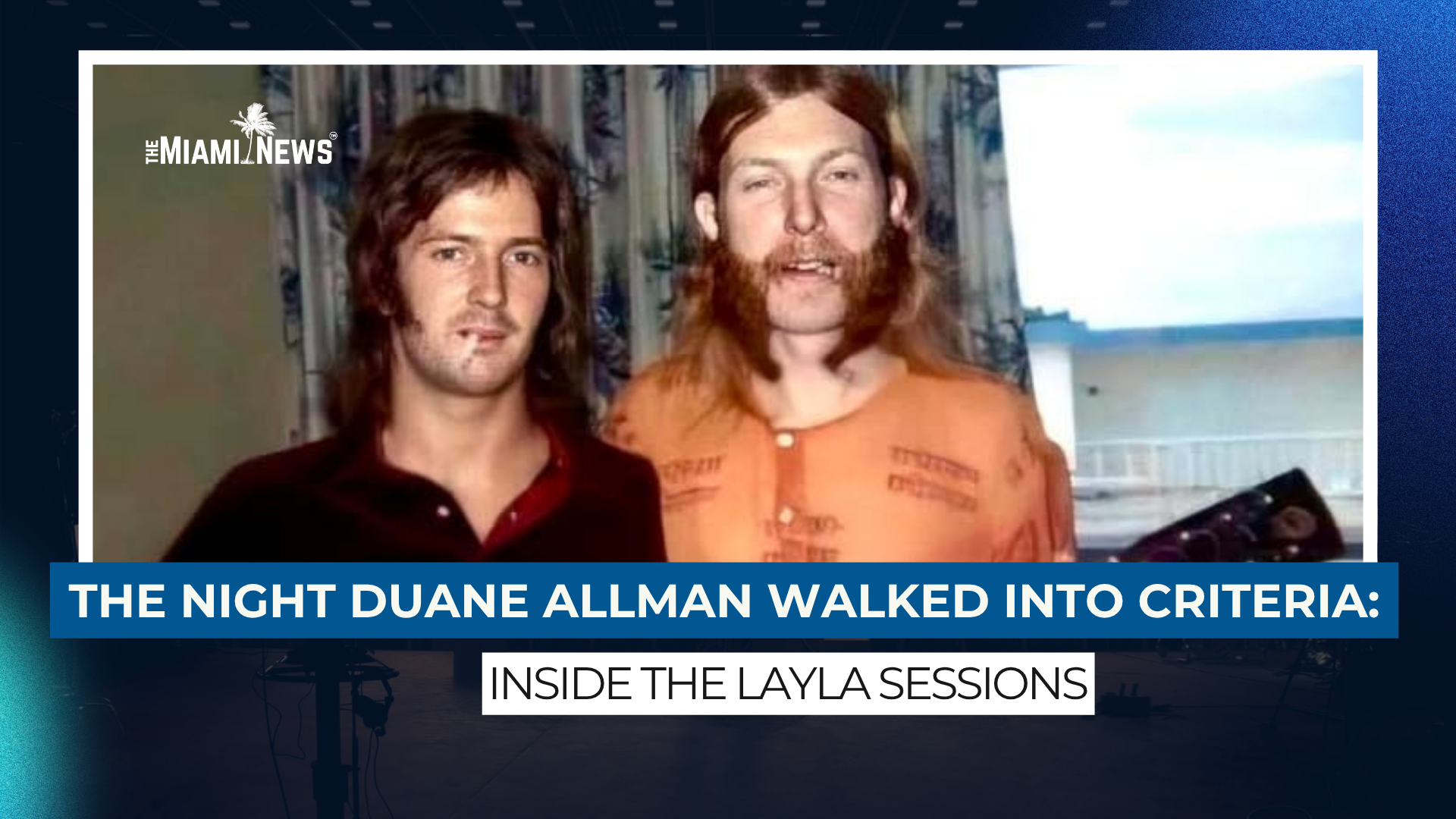
On August 26, 1970, Eric Clapton went to a benefit concert in Miami and watched the guitarist on stage freeze mid-solo at the sight of him. Hours later both men were at Criteria Studios on 149th Street, trading guitars until morning. The Layla sessions produced a commercial failure that became one of the most admired rock albums ever made — and none of it was planned.
Duane Allman was in the middle of a solo when he saw who was sitting in front of the stage.
He stopped. By every account of that night, he simply stopped playing — because Eric Clapton, the most celebrated guitarist in the world and the reason Allman had picked up a slide in the first place, had walked into a benefit show in Miami and sat down.
Afterward Clapton went backstage and delivered the invitation that made the record: “Bring your guitar; you got to play!”
They went straight to the studio and jammed until the sun came up.
Why Clapton Was in Miami at All
Clapton had come to Criteria to hide, more or less.
He had just walked away from Blind Faith and from the idea of being a guitar hero, and he had assembled a band — Bobby Whitlock on keys and vocals, Carl Radle on bass, Jim Gordon on drums — that he deliberately did not put his own name on. Derek and the Dominos toured British clubs in August 1970 under a name nobody recognised, which was the entire point.
He was also in love with his best friend’s wife.
Pattie Boyd was married to George Harrison, and the album Clapton came to Miami to make is essentially one long, barely coded letter to her. That is the emotional engine of the whole thing, and it explains the desperation you can hear on the tapes.
Tom Dowd was the reason he came to this studio. Dowd — the Atlantic Records engineer and producer who had already worked on records by Ray Charles, John Coltrane and Aretha Franklin — had produced Clapton before, in Cream. By 1970 he was practically part of the building at Criteria, which Atlantic used so heavily that the place had picked up the nickname Atlantic Studios South.
Dowd happened to be producing another band in the same rooms that summer: the Allman Brothers Band, then finishing their second album.
So when the Allmans played a benefit in Miami on August 26, Dowd knew about it. Clapton went.
The Night
What happened after the show has become one of the most retold stories in American music, and unusually for such stories, the retellings mostly agree.
The two guitarists went back to Criteria and played for hours — swapping instruments, trading phrases, neither one backing down. Dowd, who had spent his career watching musicians meet each other, described it afterward as something close to telepathy. Whitlock, Radle and Gordon were in the room too, and the band that had been quietly making a modest record suddenly was not making a modest record anymore.
Allman stayed. He was not a guest for a track or two: he played on eleven of the album’s fourteen songs.
Clapton and Allman were, by the accounts of everyone present, inseparable for the rest of the Florida sessions. Whatever the Layla sessions were supposed to be before August 26, they became something else afterward.
Who Actually Wrote the Riff
Here is the detail most people get backwards.
The seven-note figure that opens “Layla” — arguably the single most recognisable guitar phrase in rock — was not Clapton’s. Duane Allman devised it. Clapton has said so himself, repeatedly and without hedging.
Allman built it, Clapton took it up an octave, and the two of them stacked it into the wall of guitars that opens the song.
The Layla sessions are full of that sort of thing. A blues-rock record that would have been good became something stranger and better because two players kept handing each other ideas neither would have had alone.
The Other Half of the Song
Then there is the coda — the long, unhurried piano section that arrives after the guitars burn out and turns a furious song into a mournful one.
Jim Gordon, the drummer, played it and took the writing credit.
Bobby Whitlock has since said that Gordon lifted the melody from his former girlfriend, the singer Rita Coolidge, and never credited her. Coolidge confirmed the account in her 2016 memoir, describing the piece as something she had written and played for Gordon.
She has never received a credit for it. Whatever you conclude about that, the coda is the reason the song outlived its decade.
The News That Arrived Mid-Session
The album is not only “Layla,” and the rest of it is where the Florida weeks really show.
“Bell Bottom Blues” is Clapton at his least guarded. “Why Does Love Got to Be So Sad?” runs on the two guitars chasing each other. “Have You Ever Loved a Woman,” a Freddie King blues, becomes something close to a confession given who the songs were about.
And partway through the Layla sessions, the band recorded a version of Jimi Hendrix’s “Little Wing.” Clapton meant it as a tribute to someone very much alive.
Hendrix died on September 18, 1970, days later. As his biographer Michael Schumacher put it, the recording simply changed meaning underneath them.
That is the atmosphere these tapes came out of — a small group of people in a Miami studio, most of them in bad shape, working at an intensity none of them sustained afterward. Clapton was deep into heroin by then and would largely disappear for the next three years.
The Flop
Layla and Other Assorted Love Songs came out on November 9, 1970, credited to a band nobody had heard of.
It failed. The album stalled at No. 16 in the United States and the reviews were tepid. Released as a single in early 1971, “Layla” reached No. 51 and disappeared.
Duane Allman died in a motorcycle accident in October 1971, at 24.
Then, in 1972, the record company reissued the single. This time it went to No. 10 in the United States and No. 7 in Britain, and it has never really left the radio since. The album that flopped now turns up on more or less every list of the greatest rock records ever made.
Derek and the Dominos, by then, had already fallen apart. They never finished a second album.
What the Building Did
None of this happens without the room.
Consider the specific accident involved: Tom Dowd was producing two different bands at the same studio in the same weeks, which meant he knew where the Allman Brothers were playing, which meant Clapton went to the show, which meant Duane Allman ended up on eleven songs he was never booked for. Criteria had the open time, the engineers — Ron and Howie Albert, Chuck Kirkpatrick, Karl Richardson, with founder Mack Emerman also on the credits — and a producer who could keep tape rolling through an all-night jam that nobody had scheduled.
Big studios sold themselves on equipment. What they actually sold was the chance of collision.
The building is still at 1755 NE 149th Street. It ran as The Hit Factory Criteria Miami from 1999 to 2017 and went back to Criteria Studios after that, and it is still working. The full history of the place is here.
Fifty-five years on, the most famous thing that ever happened inside it remains an unbooked session between two guitarists who had met a few hours earlier. The Layla sessions are the argument for keeping rooms like this open.