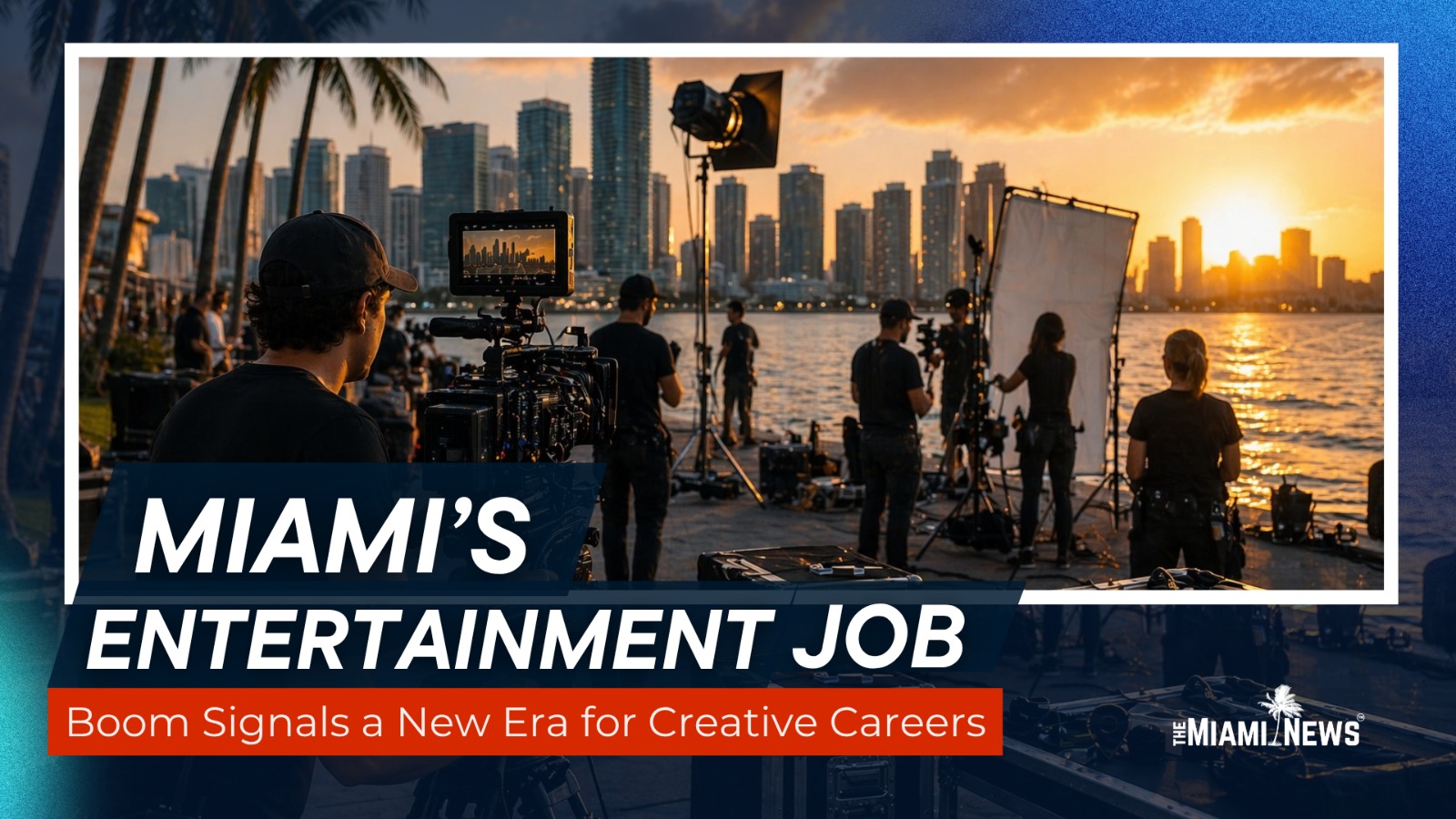
From film sets to streaming studios, a surge in demand for skilled crew is reshaping the entertainment workforce in Miami—and across the United States.
MIAMI — The entertainment industry is undergoing a hiring surge not seen in decades, and Miami has emerged as one of its fastest-growing hubs. Fueled by streaming expansion, increased content production, and state-level incentives, job opportunities for behind-the-scenes roles—from production assistants to lighting technicians—are rapidly multiplying. Industry analysts say the trend, already visible nationwide, is especially pronounced in South Florida, where demand for skilled workers is beginning to outpace supply.
On a humid morning in Wynwood, a commercial shoot unfolds with quiet precision. Crew members move swiftly between lighting rigs and camera setups, while production assistants coordinate logistics behind the scenes. These entry-level roles, once considered stepping stones, are now among the most sought-after positions in the industry.
“The volume of productions has doubled in just a few years,” said a Miami-based line producer who requested anonymity due to ongoing contracts. “We’re constantly looking for reliable crew. It’s not just about talent anymore—it’s about availability and training.”
Across the United States, the numbers tell a similar story. According to recent labor data from industry groups like the Motion Picture Association, film and television production jobs have grown steadily since 2022, driven largely by streaming platforms racing to meet global demand for content. In 2025 alone, U.S. content spending surpassed $150 billion, with a significant portion allocated to workforce expansion.
Miami’s rise within this ecosystem is no accident. The city offers a unique combination of tax incentives, diverse shooting locations, and international appeal. Productions ranging from music videos to high-budget streaming series are increasingly choosing South Florida as their base. Local officials have leaned into the momentum, promoting Miami as a cost-effective alternative to traditional production centers like Los Angeles and New York.
But with opportunity comes a challenge: a widening skills gap.
“We’re seeing people eager to break into the industry, but they don’t always understand how a set operates,” said a production coordinator working across Florida and Georgia. “Even roles like production assistants require a baseline of knowledge—set etiquette, scheduling, safety protocols. Without that, it slows everything down.”
This gap is not unique to Miami. Nationwide, studios are grappling with a shortage of trained entry-level crew members. While high-profile roles—directors, actors, writers—often dominate public perception, it is the foundational workforce that keeps productions running. From grip teams to assistant directors, the industry relies on a complex network of professionals whose work remains largely invisible to audiences.
The shift has also broadened the definition of what a career in entertainment looks like. Traditional pathways—film school, internships, relocation to Hollywood—are no longer the only options. Instead, regional markets like Miami are creating new entry points, often with faster advancement opportunities.
“There’s a democratization happening,” said a media economist at a U.S. research institute. “Technology has lowered barriers to entry, and geography matters less than it used to. What matters now is readiness—being able to step onto a set and contribute immediately.”
For many, that readiness translates into stability. Unlike the gig-based reputation the industry once carried, consistent production schedules in emerging hubs are offering more predictable income streams. Commercial shoots, branded content, digital series, and independent films collectively create year-round work, especially in cities with favorable climates and infrastructure.
Still, the pace of growth raises questions about sustainability. Some experts caution that the current boom—driven in part by aggressive streaming competition—may eventually stabilize. Others argue that the long-term trajectory remains strong, pointing to global content consumption trends and the continued expansion of digital platforms.
“Even if growth levels off, the baseline demand is much higher than it was a decade ago,” the economist noted. “This isn’t a temporary spike—it’s a structural shift.”
Back in Miami, that shift is already reshaping career trajectories. Individuals from unrelated fields—hospitality, retail, even finance—are transitioning into production roles, drawn by the promise of creative work and upward mobility. For newcomers, the appeal lies not only in the industry’s glamour but in its accessibility.
“You don’t have to be an actor or director to be part of this world,” the line producer said. “There are dozens of roles that people don’t even realize exist.”
As Miami cements its place on the entertainment map, the city’s job boom reflects a broader transformation across the industry—one where opportunity extends far beyond the spotlight. For those willing to step behind the scenes, the pathway into entertainment has never been more open—or more in demand. And as productions continue to multiply, the question is no longer whether jobs exist, but who will be ready to fill them.
Entertainment Job Growth at a Glance
- U.S. content spending (2025): $150+ billion
- Fastest-growing roles: Production assistants, grips, lighting technicians
- Key growth markets: Miami, Atlanta, Albuquerque, Vancouver
- Average entry-level day rate (U.S.): $150–$250
- Estimated job growth (film/TV sector, 2022–2025): +18%









Be First to Comment