
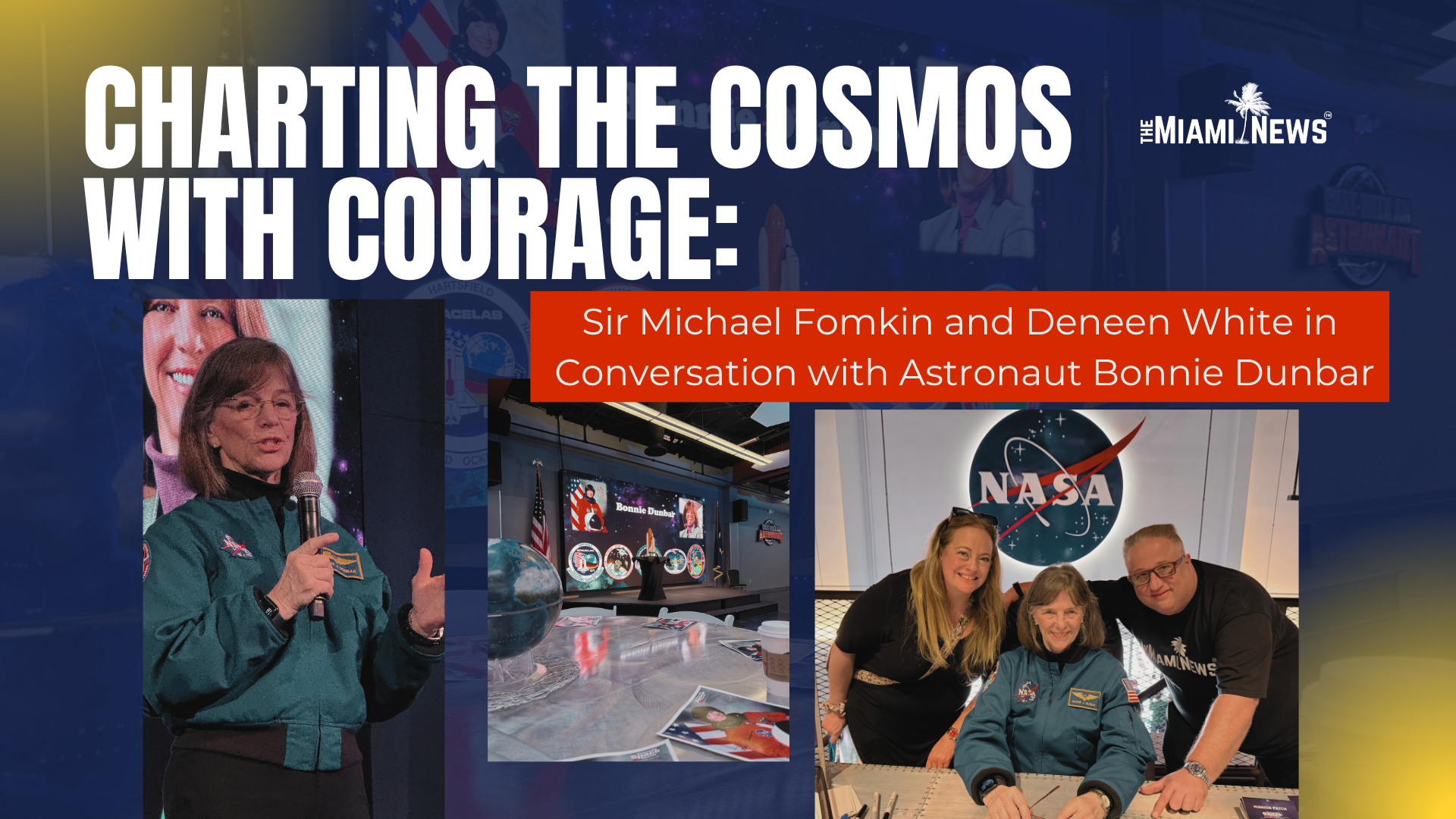
In a riveting exchange, Dr. Dunbar reflects on AI, fear, and the future of space exploration, revealing how bold thinking and human resilience continue to define the next frontier.
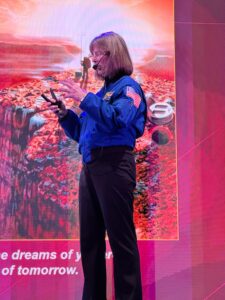
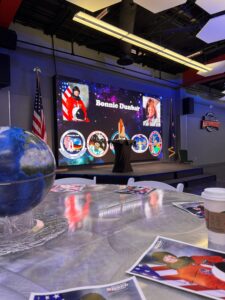
In a darkened auditorium illuminated by the red glow of imagined Martian landscapes, a striking image appeared on the screen. A lone astronaut stood on the edge of a canyon, gazing into the distance as the sun rose over alien terrain. Beneath it, the words of rocket pioneer Dr. Robert Goddard set the tone for the conversation to follow:
“It is difficult to say what is impossible. For the dreams of yesterday become the hopes of today, and the realities of tomorrow.”
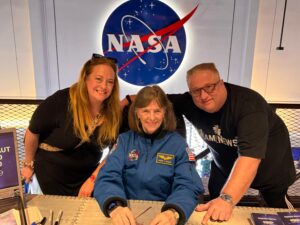
For astronaut, engineer, and educator Dr. Bonnie J. Dunbar, who recently sat down with Sir Michael Fomkin and Deneen White, this quote is more than an ideal—it is a guiding principle. Over the course of their interview, she offered a powerful glimpse into the future of space travel, the role of artificial intelligence, and how fear can either limit or liberate us.
The Human-Machine Partnership in Space
“AI is going to be critical for long-duration missions,” Dunbar said, as she reflected on the challenges astronauts will face during deep space exploration. Missions to Mars or beyond may require full autonomy, where decisions can no longer wait for Earth-bound instruction. “When you’re millions of miles from home, you need systems that can think, adapt, and support human judgment in real time,” she explained.
Dunbar, who began her career as a mechanical and biomedical engineer at NASA before becoming an astronaut, made clear that artificial intelligence will not replace astronauts, but rather amplify their capabilities. Intelligent systems may help monitor spacecraft systems, interpret health diagnostics, or even assist with construction and repairs in the unforgiving environment of space.
However, she also cautioned that the success of these technologies hinges on trust. “We need to train astronauts not just technically, but psychologically, to trust these systems,” she said. “That trust will be earned through design, transparency, and rigorous testing.”
For Dunbar, technology alone is not the solution. It must be paired with courage, a theme that threaded through her reflections.
Choosing Courage Over Comfort
Discussing the emotional and psychological dimensions of space travel, Dunbar was candid about the presence of fear. “Fear is a natural response to the unknown. But it cannot be the final response,” she said. “You acknowledge it, learn from it, and then move forward anyway.”
This mindset, she shared, has helped her through every launch, every setback, and every mission. It is also why she draws strength from one of her favorite quotes by Theodore Roosevelt:
“Far better it is to dare mighty things, to win glorious triumphs, even though checkered by failure, than to take rank with those poor spirits who neither enjoy much nor suffer much, because they live in the gray twilight that knows neither victory nor defeat.”
“This,” she said with conviction, “is the essence of exploration.” To her, the quote is not just about ambition—it is about the moral imperative to rise above mediocrity, to engage with uncertainty, and to embrace the full range of human experience.
A Life of Firsts, and a Legacy in Progress
Bonnie Dunbar knows that spirit firsthand. Raised on a cattle ranch in rural Washington State, she grew up fixing farm equipment and dreaming about space. She went on to earn a doctorate in mechanical and biomedical engineering and to become a key figure at NASA.
Over the course of her extraordinary career, she flew on five Space Shuttle missions: STS-61A, STS-32, STS-50, STS-71, and STS-89. She logged over 1,200 hours in space, orbiting the Earth more than 800 times. She was among the first Americans to travel to the Russian Mir Space Station and helped pioneer microgravity research that is foundational to today’s missions.
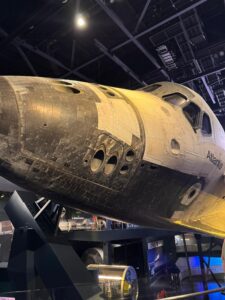
Now, as a professor and mentor at the University of Houston, Dunbar is investing in the next generation of aerospace innovators. “We have a responsibility to pass on not just the knowledge, but the mindset,” she said. “The willingness to question, to trust, to act even when the outcome is uncertain.”
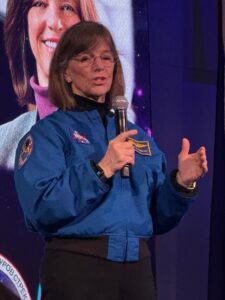
Sir Michael Fomkin described the experience of speaking with Dunbar as “a lesson in courage.” Deneen White added, “She is everything you hope a space traveler would be—brilliant, bold, and deeply human. Bonnie doesn’t just talk about the future. She lives like she’s building it.”
The Road Ahead
As space agencies and private companies chart ambitious courses to the Moon, Mars, and beyond, Dunbar believes our greatest asset will not be the machines we build, but the mindset we carry with us. The kind that sees the impossible as merely unfinished. The kind that chooses action over apathy.
“Space is the ultimate mirror,” she said in closing. “It shows us who we are and who we dare to become.”









Be First to Comment