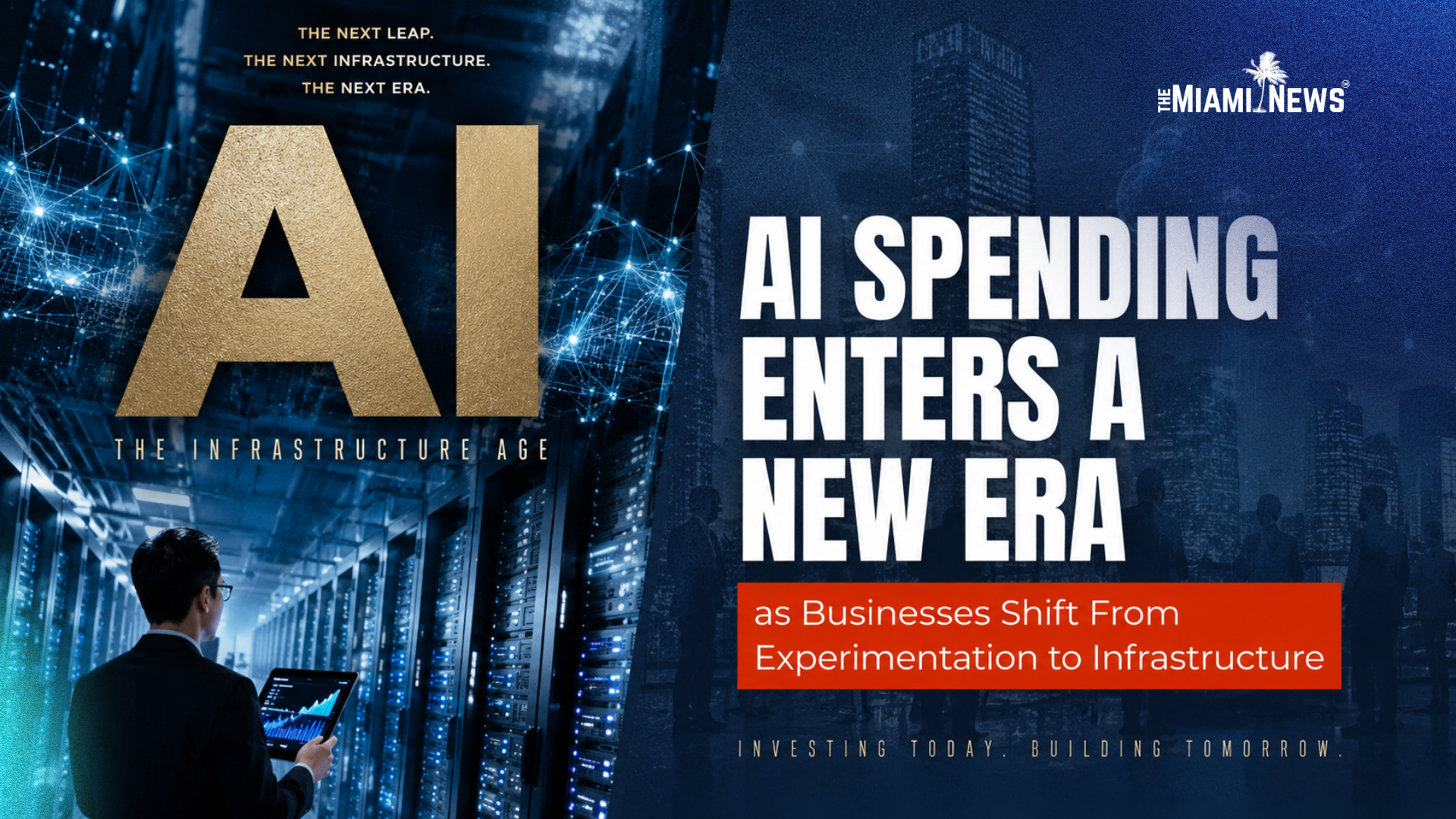
Companies are moving beyond artificial intelligence pilots and investing billions in permanent AI systems, reshaping corporate strategy, employment and global competition.
NEW YORK — Artificial intelligence has entered a new phase. After nearly three years of rapid experimentation following the launch of generative AI tools, businesses worldwide are committing unprecedented capital to AI infrastructure, data centers, enterprise software and workforce training. Rather than asking whether AI belongs in the workplace, executives are now focused on how quickly they can integrate it into everyday operations without compromising security, governance or employee trust.
Technology analysts say 2026 is becoming the year AI transitions from an innovation project to core business infrastructure.
From Pilot Projects to Boardroom Priorities
Only a few years ago, many companies viewed AI as a promising but uncertain investment. Pilot programs often remained confined to marketing departments or software engineering teams, producing mixed results and raising questions about cost, reliability and regulation.
Today, the conversation inside boardrooms has fundamentally changed.
Major banks are deploying AI to automate compliance reviews. Healthcare organizations are using advanced language models to assist clinicians with documentation. Manufacturers are leveraging AI-powered predictive maintenance to reduce downtime, while retailers are improving inventory forecasting and customer service through increasingly sophisticated automation.
According to recent industry surveys from global consulting firms including McKinsey and Deloitte, a growing majority of executives now report measurable returns from AI adoption, particularly in productivity, operational efficiency and customer engagement. At the same time, enterprise software providers are racing to integrate AI into nearly every business application, from finance and legal services to human resources and supply chain management.
“AI is no longer a side project,” said Daniel Mercer, a technology strategist with Horizon Analytics. “For many organizations, it’s becoming as fundamental as cloud computing was a decade ago. Companies that delay adoption risk falling behind competitors that are already redesigning how work gets done.”
The Infrastructure Race Accelerates
Behind the scenes, the AI boom is fueling one of the largest technology infrastructure expansions in recent memory.
Global demand for advanced semiconductors, cloud computing capacity and energy-intensive data centers continues to surge. Companies such as Microsoft, Google, Amazon and Meta have announced multibillion-dollar investments in AI infrastructure, while semiconductor manufacturers are expanding production to meet demand for high-performance chips capable of training and running increasingly complex AI models.
This unprecedented buildout has also attracted governments eager to strengthen domestic AI capabilities. The United States, European Union, Japan and several Middle Eastern nations have introduced initiatives designed to support semiconductor manufacturing, encourage AI research and secure critical technology supply chains.
The competition extends beyond commercial interests. Policymakers increasingly view AI infrastructure as a matter of national competitiveness, comparable to telecommunications or energy security.
“The next decade will be defined not only by who develops the most advanced AI models,” Mercer noted, “but by who owns the computing infrastructure that powers them.”
Workers Adapt to an AI-Enabled Workplace
The rapid integration of AI has intensified discussions about the future of work.
While automation is replacing certain repetitive tasks, economists argue that AI is more likely to reshape jobs than eliminate them outright. Employees are increasingly expected to work alongside AI systems, using them to draft reports, analyze data, summarize meetings and generate creative content more efficiently.
Companies are responding by investing in workforce training. Corporate learning programs focused on AI literacy have expanded significantly during the past year, with employers encouraging staff to develop skills in prompt engineering, data analysis and AI oversight.
Still, concerns remain.
Labor organizations have called for stronger protections surrounding transparency, employee monitoring and algorithmic decision-making. Privacy advocates continue to push for clearer regulations governing how workplace AI systems collect and process personal information.
“We’re entering a period where AI governance is just as important as AI innovation,” said employment attorney Rachel Kim. “Businesses that establish clear ethical standards today will be better positioned to earn the trust of employees and customers tomorrow.”
Regulation Begins to Catch Up
Governments are also moving more aggressively to establish guardrails.
The European Union’s AI Act is beginning to shape compliance strategies for multinational corporations, particularly those developing or deploying high-risk AI systems. Meanwhile, regulators in the United States are increasingly scrutinizing issues involving copyright, consumer protection, cybersecurity and transparency.
Many multinational firms are creating dedicated AI governance teams responsible for evaluating new applications before deployment, conducting risk assessments and ensuring compliance across multiple jurisdictions.
Industry experts expect regulatory frameworks to continue evolving as AI capabilities expand into healthcare, finance, education and public services.
Despite growing oversight, investment shows little sign of slowing. Venture capital funding remains robust, enterprise adoption continues to accelerate and nearly every major technology conference in 2026 has placed artificial intelligence at the center of its agenda.
Miami’s Opportunity in the AI Economy
For South Florida, the global AI boom presents both challenges and opportunities.
Miami has spent the past several years positioning itself as a technology hub, attracting startups, venture capital firms and entrepreneurs seeking alternatives to traditional innovation centers. Local universities have expanded AI research programs, while business incubators are encouraging companies focused on machine learning, cybersecurity and financial technology.
Economic development leaders believe the region can capitalize on growing demand for AI talent by investing in education, workforce development and digital infrastructure.
“We have an opportunity to build an innovation ecosystem that serves not just Florida but the broader Americas,” said Maria Gonzalez, executive director of the Miami Technology Partnership. “Success will depend on preparing today’s workforce for tomorrow’s economy.”
Looking Ahead
Artificial intelligence is no longer defined by flashy demonstrations or experimental chatbots. It is becoming embedded in the everyday machinery of business, influencing decisions, accelerating workflows and redefining competitive advantage.
For executives, the challenge is no longer whether to invest in AI but how to do so responsibly. For employees, continuous learning is becoming a professional necessity. And for governments, the task is balancing innovation with accountability.
The companies that thrive in this new era may not be those with the most advanced algorithms, but those that successfully combine technology with human judgment, ethical governance and long-term strategy. As AI moves from the laboratory into every corner of the global economy, its true impact will be measured not only by what it can automate, but by how it transforms the way people work, create and compete.
Sidebar | AI Economy by the Numbers
- Enterprise AI investment continues to grow at double-digit rates globally.
- Major technology companies have committed hundreds of billions of dollars to AI infrastructure and data centers.
- AI adoption is expanding across healthcare, finance, manufacturing, retail and professional services.
- Governments worldwide are introducing new regulations governing high-risk AI systems and data transparency.
- Workforce AI training has become a top corporate priority for 2026.