
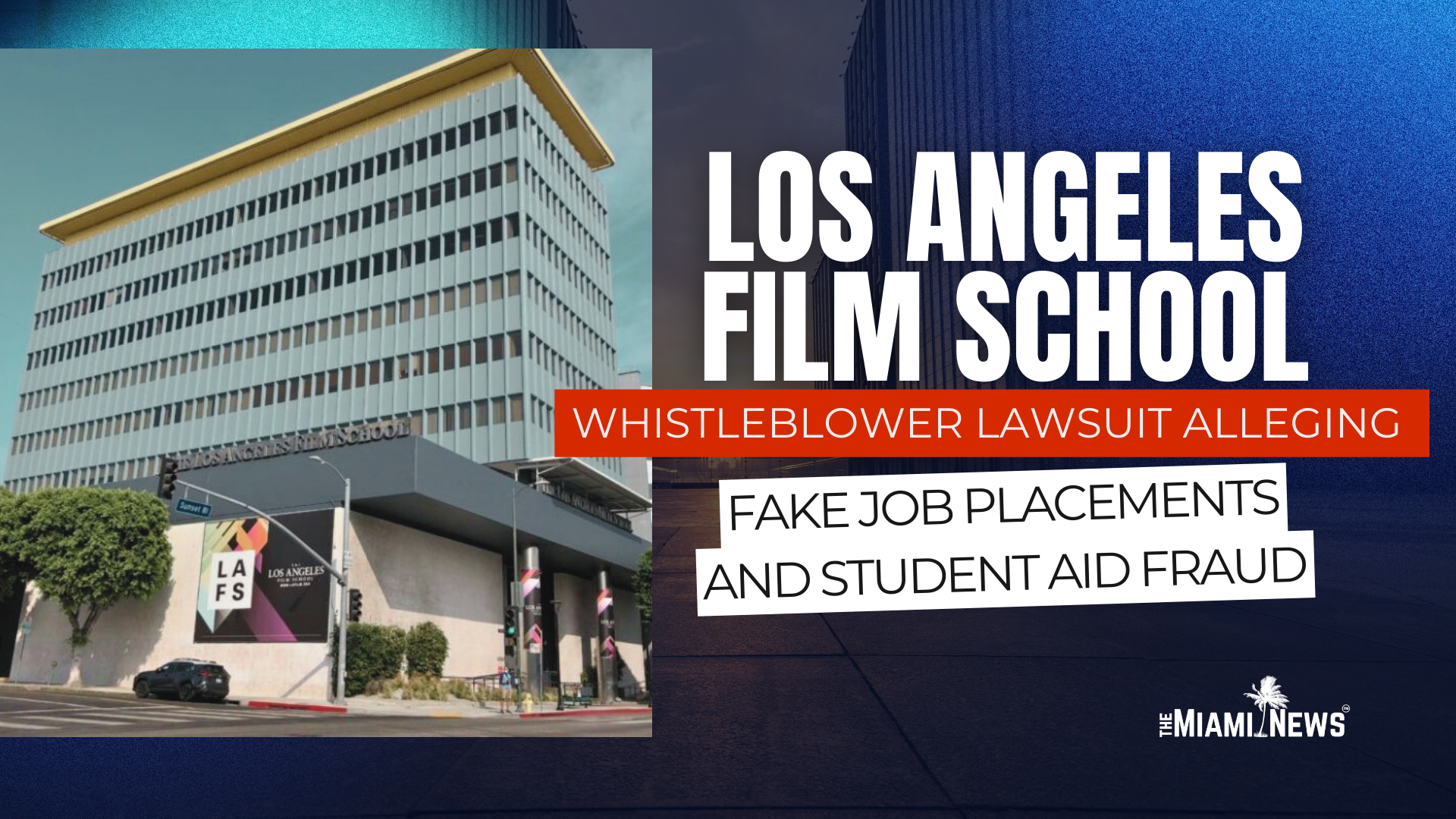
Former senior executives accuse the Hollywood-based institution of engineering thousands of sham jobs to secure federal funding, raising renewed scrutiny of for-profit education.
Two former senior executives at the Los Angeles Film School have accused the institution of running what they describe as a long-running scheme to fraudulently secure federal student aid by fabricating job placements for graduates, according to a whistleblower lawsuit unsealed earlier this year.
The lawsuit, filed in 2024 by Dave Phillips, the school’s former vice president of career development, and Ben Chaib, its former vice president of admissions, alleges that the school systematically created fake or short-term employment opportunities to falsely inflate graduate job placement rates. Those figures were allegedly used to satisfy federal accreditation requirements and maintain eligibility for tens of millions of dollars in student loans and veterans’ education benefits.
At the center of the case is a claim that “nearly all” of the school’s annual federal aid revenue was obtained through misrepresentation.
Allegations of a Manufactured Employment Pipeline
According to the complaint, the Los Angeles Film School, which operates on Sunset Boulevard in Hollywood and offers two- and four-year degrees in film, music production, animation, and related fields, charged tuition ranging from roughly $40,000 to $80,000 per program.
Phillips and Chaib allege that while students were promised viable career pathways, internal data told a different story. The lawsuit cites internal documents suggesting that most graduates earned between $0 and $5,000 annually in their chosen field and that the majority were unable to secure entry-level industry positions.
To compensate, the lawsuit claims, school executives “engineered” employment outcomes. The former executives allege that Los Angeles Film School paid outside entities, including Ivar Music Group, nearly $1 million between 2010 and 2017 to temporarily “hire” graduates for brief, low-paying jobs. These roles allegedly lasted as little as two days and were tightly controlled by the school, including decisions about who was hired, when they worked, and how much they were paid.
The goal, the suit alleges, was to create the appearance that at least 70 percent of graduates were employed in their field, a benchmark required to maintain accreditation and continued access to federal funding.
Federal Aid at Stake
The lawsuit claims that the Los Angeles Film School receives approximately $85 million annually in federal assistance, including about $60 million in student loans and roughly $19 million in veterans’ education benefits.
The school is owned by CEO James “Bill” Heavener and three partners, who also control Full Sail University in Winter Park, Florida. The complaint alleges that Full Sail receives approximately $377 million per year in federal assistance and engaged in similar practices to bolster job placement numbers.
Together, the schools are accused of self-financing thousands of temporary or nominal jobs through nonprofits and vendors to mislead both students and federal regulators into believing graduates were gainfully employed.
School Denies Claims, Cites Prior Settlement
In court filings submitted last week, attorneys for the Los Angeles Film School rejected the allegations, arguing that Phillips and Chaib are attempting to revive claims that were previously investigated and resolved by the U.S. Department of Education.
The school is expected to file a motion to dismiss the lawsuit on Oct. 1. Its attorneys maintain that the Department of Education conducted a comprehensive investigation between 2017 and 2020 that resulted in a settlement, effectively closing the matter.
The whistleblower complaint also alleges that the school violated federal law by tying recruiter compensation to student enrollment and then concealing that incentive structure during a 2017 Department of Education audit.
Accreditation and Oversight Questions
Despite the allegations, the Accrediting Commission of Career Schools and Colleges renewed the Los Angeles Film School’s accreditation in 2023 for a five-year term. The accrediting body did not respond to requests for comment.
Phillips, a former William Morris agent, served for more than a decade as a senior executive at the school and advised its board. Chaib also worked at the school for 12 years after holding admissions roles at other for-profit institutions, including Heald College and the University of Phoenix.
Phillips left the school in 2022 after his contract was not renewed. A subsequent lawsuit filed by the school accused him of secretly recording conversations with senior leadership, including Heavener and school president Tammy Elliott. That case was later dismissed, and the school reached a settlement with Phillips in 2023. Chaib reached a separate settlement with the school in 2021.
The school now argues that both men had released their claims and are pursuing the whistleblower case as an attempt to extract additional compensation.
A Familiar Pattern in For-Profit Education
The U.S. Department of Justice declined to intervene in the case in May, a procedural decision that allowed the lawsuit to be unsealed. Under federal whistleblower law, private individuals who expose fraud against the government may receive between 25 and 30 percent of any recovered funds.
The allegations echo earlier crackdowns on for-profit colleges during the 2010s, a period marked by sweeping regulatory reforms and high-profile closures. Corinthian Colleges, which owned Heald College, and ITT Technical Institute both collapsed following federal and state investigations.
In 2009, the University of Phoenix paid $67.5 million to settle a whistleblower case involving incentive-based recruitment compensation, awarding $19 million to the two former employees who brought the case. In 2015, the Department of Education fined Heald College $29.7 million for misrepresenting job placement statistics.
The Takeaway
The lawsuit against the Los Angeles Film School reopens uncomfortable questions about accountability, transparency, and oversight in the for-profit education sector. As student debt remains a defining economic issue for millions of Americans, the case underscores how job placement claims can shape lives, finances, and futures long after graduation caps are tossed.
Editor’s note: The Miami News will continue to follow developments as the case proceeds through federal court.









Be First to Comment