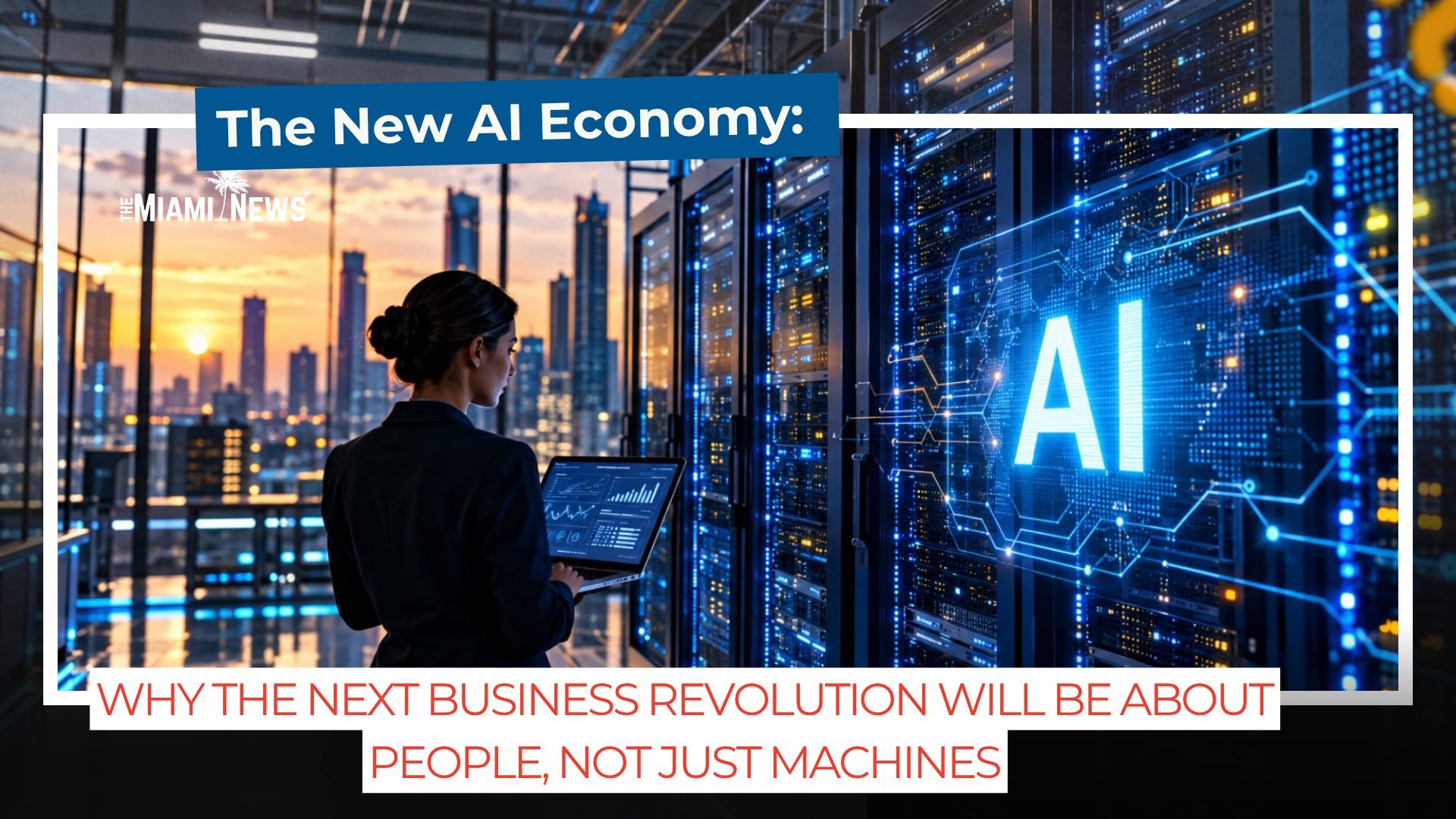
As artificial intelligence moves from experimentation into everyday operations, companies face a defining question: Will technology replace human potential or unlock it?
Artificial intelligence is rapidly transforming the global business landscape, reshaping how companies operate, how employees work and how industries compete. From financial institutions in New York to technology startups in Miami and manufacturing companies across Asia, AI is becoming an essential component of corporate strategy. Yet behind the extraordinary pace of technological development lies a more complicated economic reality: installing intelligent software is considerably easier than redesigning an organization to use it effectively.
According to Stanford University’s 2025 AI Index Report, 78% of surveyed respondents said their organizations used artificial intelligence in 2024, compared with 55% in 2023. The share reporting generative AI use in at least one business function more than doubled, rising from 33% to 71%.
These figures demonstrate how quickly AI has entered mainstream business operations. They do not, however, establish that every investment has produced substantial financial returns.
From technological excitement to measurable results
For executives, the central question is shifting from what AI can accomplish to what it can accomplish profitably.
Companies are introducing automated customer-service systems, AI-assisted marketing platforms, predictive analytics and software-development tools. These technologies promise to reduce repetitive work, improve decision-making and allow employees to concentrate on more complex responsibilities.
But measurable financial benefits remain uneven.
Stanford’s AI Index found that among respondents reporting savings from AI in service operations, most estimated those savings at less than 10%. Revenue gains were similarly modest in many business functions.
The findings suggest that the competitive advantage may not belong simply to companies purchasing the most advanced systems. It may belong to organizations capable of combining technology with disciplined management, reliable data and appropriately trained employees.
The workforce question
The consequences for employment remain among the most consequential uncertainties surrounding artificial intelligence.
AI can perform tasks once requiring substantial human attention, including document analysis, routine coding, customer inquiries and preliminary financial research. That creates opportunities for greater productivity, but it also raises questions about entry-level employment, professional training and the future distribution of economic rewards.
An organization that automates junior-level work may reduce short-term costs while unintentionally weakening the training pipeline for future managers and specialists.
This challenge is particularly significant for young professionals. If technology assumes responsibility for foundational tasks, employers will need new approaches to teaching judgment, communication and technical expertise.
Educational institutions face similar pressure. Preparing students for a world of intelligent software requires more than teaching them to operate individual applications. It requires strengthening analytical reasoning, creativity, digital literacy and the ability to evaluate machine-generated information critically.
Why smaller companies could benefit
Although major technology corporations dominate investment in advanced AI systems, smaller businesses may find significant opportunities in accessible applications.
A hospitality company could use AI to improve scheduling and forecast demand. A retailer could analyze purchasing patterns. A professional-services firm could accelerate research and administrative work.
For entrepreneurs in Miami, a city with commercial connections across North America, Latin America and the Caribbean, multilingual tools and digital customer-service platforms could make international expansion more practical.
However, affordability does not eliminate risk. Smaller companies often lack dedicated cybersecurity teams, data-governance specialists and the financial resources to recover from poorly implemented technology.
Responsible adoption therefore requires clear policies concerning customer information, employee oversight and the accuracy of automated outputs.
The next competitive advantage
The global AI economy is likely to reward more than computational power.
Companies must decide where human supervision is indispensable, how workers should share in productivity gains and whether technology genuinely improves the experiences of customers.
Governments face a related challenge: encouraging innovation without allowing its benefits to become excessively concentrated among a narrow group of companies and highly skilled workers.
The transformation now underway is not simply a contest between people and machines. It is a test of whether institutions can adapt quickly enough to make increasingly powerful technology economically productive and socially beneficial.
The companies that succeed may ultimately be distinguished not by how many tasks they automate, but by how intelligently they invest in the people who remain essential to their success.
Source: Stanford University, Artificial Intelligence Index Report 2025.