
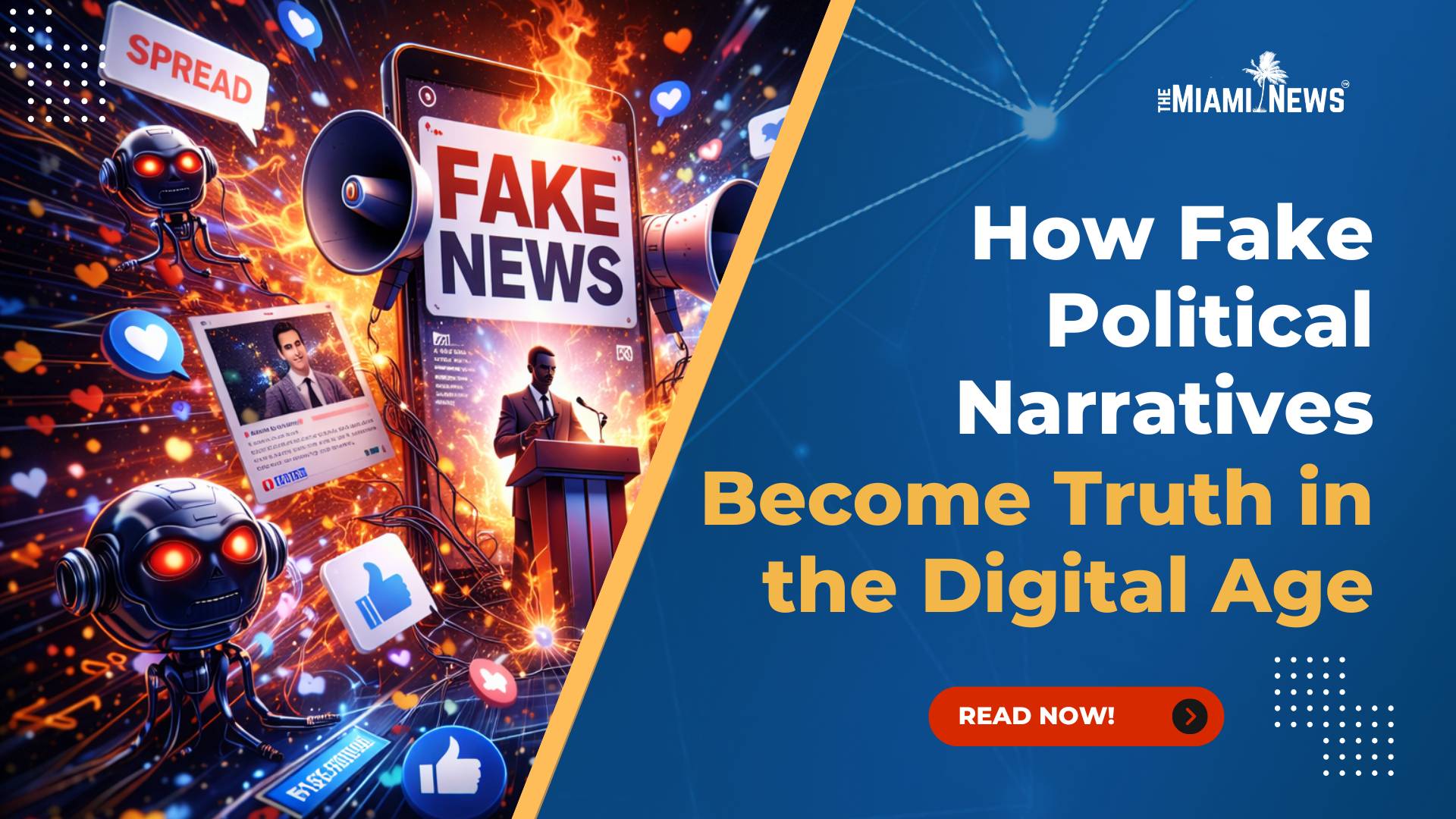
Inside the invisible machinery of misinformation and why truth needs better defenders than ever before.
In the digital public square of 2026, false political narratives don’t just survive; they thrive. Fueled by emotional certainty and algorithmic acceleration, they outpace verified information, distort civic understanding, and destabilize public trust across borders. Understanding how these narratives form and spread has become a democratic necessity, not just a media concern.
Most of today’s viral political misinformation doesn’t begin as outright lies. Instead, it emerges from truth fragments, legitimate headlines or real-world events, that are stripped of context and reassembled into something deceptively coherent. “What we often see is a collage of real data points, remixed into a false storyline that feels persuasive,” says Maria Torres, a disinformation researcher at the Digital Literacy Lab. “It is narrative engineering, not news reporting.”
From Fact to Fiction: The Narrative Recipe
Consider a hypothetical example: a government announces the seizure of foreign assets. On its own, this is a legal and often bureaucratic event. But pair it with another article about a politician’s business gains and a third on national debt, and a misleading storyline can emerge: that the politician personally profited from the seizure. None of these stories are false individually, but their fusion is pure invention.
This is the essence of many false narratives. They compress complexity into intentionality, turning structural policy into personal schemes. “The logic feels intuitive: policy equals profit, power equals theft. But that intuition is emotionally driven, not factually supported,” Torres explains.
Personalization Over Process
One reason these distortions gain traction is their tendency to collapse the line between institutions and individuals. Government actions, corporate decisions, or global economic trends are reframed as the conscious acts of single actors. The state becomes a person; complex systems are reduced to motives.
“Misinformation thrives on simplicity,” says Kevin Han, an analyst at the Global Integrity Forum. “If a reader can blame someone instead of understanding something, they are more likely to believe and share.” This personalization makes the narrative feel accessible and urgent, but it also removes essential context.
Why Falsehoods Fly Faster
Psychological research and platform design both play a role in the viral nature of misinformation. First, fake narratives are framed with absolute certainty. They eliminate nuance and present bold claims as indisputable. This confidence, regardless of accuracy, is often interpreted as credibility.
Second, these posts offer clear villains and unambiguous morality. They make sense of chaos, assign blame, and create identity-based solidarity. “It feels good to think you have figured it out,” says Han. “That emotional reward system is deeply embedded in how content is shared.”
Third, emotional resonance trumps verification. Anger and outrage drive engagement more than caution or evidence. And with many platforms prioritizing reach over rigor, the most reactive content wins.
Lastly, the illusion of specificity, numbers, charts, insider language, adds to the deception. These tools mimic journalistic credibility while bypassing its standards.
The Long-Term Cost
Repeated exposure to these false narratives has a corrosive effect. Over time, they erode trust not through contradiction, but through coherence. If everything seems rigged, then nothing can be trusted. Real journalism is dismissed as incomplete or complicit, while speculation is elevated as courage.
“We are seeing a dangerous inversion,” warns Torres. “The less substantiated the claim, the more people think it must be true, because no one else is ‘brave’ enough to say it.”
This erosion of trust undermines societal capacity to address actual corruption, economic instability, or abuse of power. In a world where every fact can be reframed as fiction, accountability becomes elusive.
Journalism’s Enduring Value
In contrast to misinformation, journalism operates under verification standards. It differentiates between sources and speculation. It timestamps claims, cites evidence, and admits uncertainty when necessary. These practices do not just build stories; they build public resilience.
Truth is often slower, less satisfying, and harder to grasp. But it is also essential. In today’s media landscape, journalism’s role is not to out-shout falsehoods but to outlast them.
A Civic Skill: Discernment
Stopping misinformation is not just a job for tech companies or newsrooms. It requires active participation from readers. Before sharing, ask: Who said this? Where is the evidence? Does this explain a system, or just assign blame?
In an age where every post has the potential to shape political belief, critical thinking is not just useful; it is essential. As Torres puts it: “We do not need more viral content. We need more viral discernment.”
Discernment is not skepticism alone; it is the pursuit of understanding.















Be First to Comment