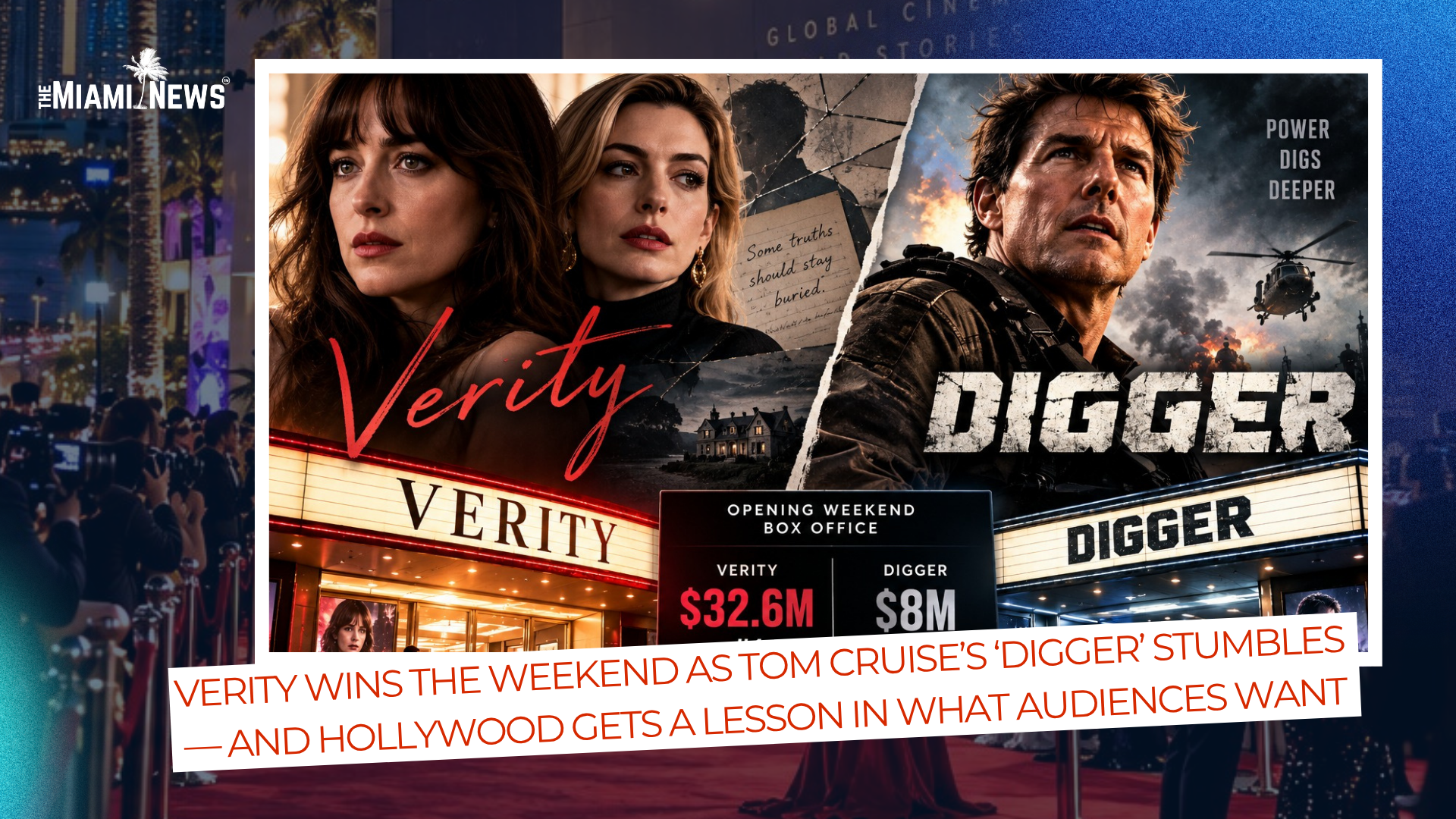
A $32.6 million box office opening for Verity, the Colleen Hoover adaptation, and an $8 million debut for an expensive Tom Cruise original reveal the widening gap between recognizable stories and costly creative gambles.
NEW YORK — Hollywood received two sharply different messages from moviegoers during the first weekend of October.
Amazon MGM’s Verity, adapted from Colleen Hoover’s bestselling novel and starring Dakota Johnson and Anne Hathaway, opened at No. 1 at the North American box office with approximately $32.6 million. Meanwhile, Warner Bros.’ Digger, an ambitious original satire directed by Alejandro G. Iñárritu and starring Tom Cruise, managed only about $8 million domestically.
The contrast is difficult to ignore.
One film arrived with a built-in readership and a recognizable literary brand. The other relied on two of cinema’s most celebrated names — Cruise and Iñárritu — and the fading Hollywood proposition that a major star paired with a major director can itself constitute intellectual property.
This weekend, the book won.
Why Verity Won the Box Office
Verity, directed by Michael Showalter, follows a writer recruited to complete a bestselling series for an incapacitated author, played by Hathaway. Its performance extends Hollywood’s profitable relationship with Hoover’s work and illustrates the commercial power of adaptations with large existing audiences.
The film’s performance is particularly notable because critical enthusiasm was not required to generate a strong opening. Its audience familiarity existed before the first trailer appeared. Millions of readers already knew the title, characters and premise.
That has enormous value in a fragmented media environment.
Studios once relied heavily on television advertising and movie stars to turn unknown stories into mass-market events. Today, audiences divide their attention among streaming platforms, social networks, games, podcasts and countless other forms of entertainment. A bestselling novel arrives with something studios increasingly struggle to manufacture: awareness.
Digger’s Costly Stumble
Digger faced the opposite problem.
The Warner Bros. production reportedly cost at least $125 million to make and opened to approximately $20 million worldwide after earning about $12 million across international markets. Its $8 million domestic launch represented one of Cruise’s weakest openings in decades.
The disappointment is more than a bad weekend for one studio. It touches a larger argument about whether Hollywood can continue financing expensive original films for adult audiences.
Cruise has spent years presenting himself as one of theatrical cinema’s most forceful advocates. Iñárritu is a filmmaker associated with ambitious, director-led projects. In another era, that combination might have been considered an event by definition.
In 2026, audiences appear to require more convincing.
That does not necessarily mean moviegoers have rejected originality. Lower-budget films can still turn modest openings into strong financial outcomes, and unusual projects continue to break through when word of mouth and cultural momentum align.
The problem is cost.
A $15 million original film does not need blockbuster attendance to become successful. A production costing well above $100 million has far less room for error. The economics make each disappointing opening an argument inside studio boardrooms for recognizable franchises, adaptations and sequels.
The lesson is not that audiences only want franchises or adaptations. It is that familiarity has become increasingly valuable — and expensive originality increasingly vulnerable.
That leaves Hollywood with a strategic problem. An industry that stops taking creative risks eventually runs out of new franchises to exploit. Yet studios cannot repeatedly spend blockbuster sums on original movies that fail to attract blockbuster audiences.
The future may therefore belong not to fewer original films, but to more disciplined ones: ambitious movies whose budgets reflect the realistic size of their audience.