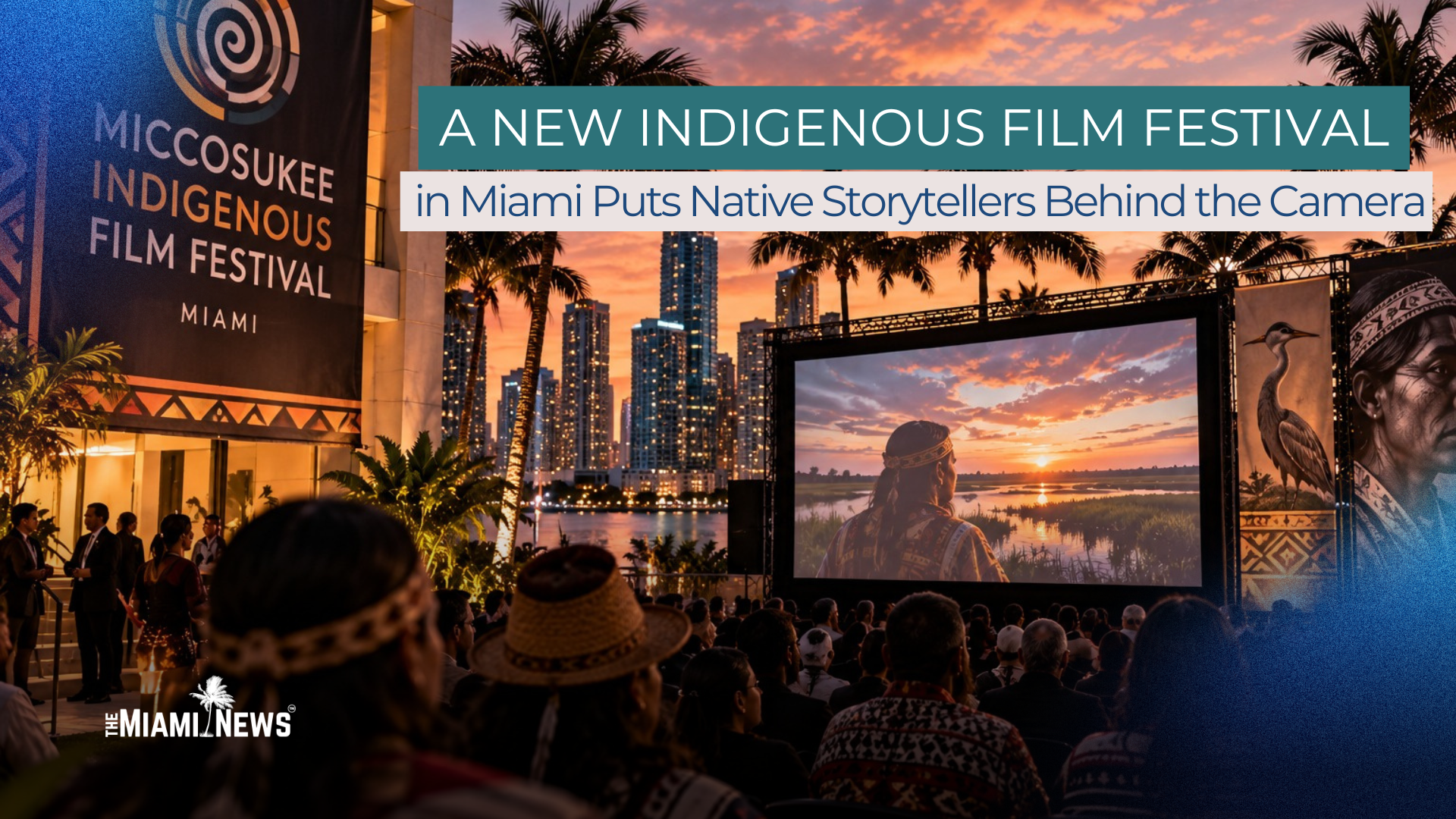
The inaugural Miccosukee Indigenous Film Festival brings 23 films to Coral Gables, creating a platform where Indigenous communities are not simply subjects of cinema but authors of their own stories.
CORAL GABLES, Fla. — A new film festival opening at the University of Miami this month is built around a deceptively important idea: Indigenous people should have the opportunity to tell Indigenous stories themselves.
The inaugural Miccosukee Indigenous Film Festival, opening Oct. 9 at the Bill Cosford Cinema, will present 23 films from the United States, Canada, Australia and other countries during four days of documentaries, narrative features and short films. The program runs through Oct. 12 and includes filmmaker discussions and an awards ceremony.
The festival arrives at a moment when questions of representation in global entertainment have moved beyond who appears on screen to who controls the camera, financing, script and narrative.
Organizers have made that principle part of the festival’s eligibility rules. Every submitted film was required to have an Indigenous connection: it could be written, directed or produced by members of Indigenous communities, feature Indigenous actors in leading roles, or focus meaningfully on Indigenous cultures.
Miccosukee Chairman Talbert Cypress summarized the festival’s underlying message in strikingly direct terms: “We have been here and we always will be here.”
Inside the Festival Program
The program begins with Nunkui, centered on a young girl in a Shuar community who dreams of the feminine spirit of the orchard while learning songs and cultivation traditions from her aunt. The festival then expands across continents and forms, with works including When Fire Turns to Ash, Raised by the Canoe, Ice, Stone, Spirit: Uncovering the Stories of Yellowstone’s First People and Breakpoint: The Untold Story of the Constitution Express.
The range is significant. Indigenous cinema is sometimes treated by mainstream cultural institutions as a single category, despite encompassing communities separated by enormous geographic, linguistic and historical differences. A festival bringing together work from several countries offers audiences a chance to recognize those distinctions rather than flatten them.
Why the Miccosukee Indigenous Film Festival Matters in Miami
Miami is a particularly meaningful place for that conversation.
The Miccosukee Tribe’s history is inseparable from South Florida, yet the city’s international identity can sometimes obscure the Indigenous history of the land beneath its highways, towers and neighborhoods. A film festival cannot correct that imbalance by itself, but it can create a public space in which contemporary Indigenous voices are encountered as living cultural forces rather than historical footnotes.
The broader entertainment industry has gradually recognized the commercial and artistic value of culturally specific storytelling. But visibility alone is not the same as agency. Casting Indigenous performers in mainstream productions represents one kind of progress; creating sustainable pathways for Indigenous writers, directors, producers and film institutions represents another.
That is why smaller festivals can matter far beyond their box-office footprint. They create networks between filmmakers, audiences and institutions, while giving work that might struggle for theatrical distribution a physical place to be seen and discussed.
For Miami, the Miccosukee Indigenous Film Festival adds another layer to an increasingly crowded October film calendar. For Indigenous filmmakers, its greater promise lies in something more fundamental: the possibility that representation becomes authorship.