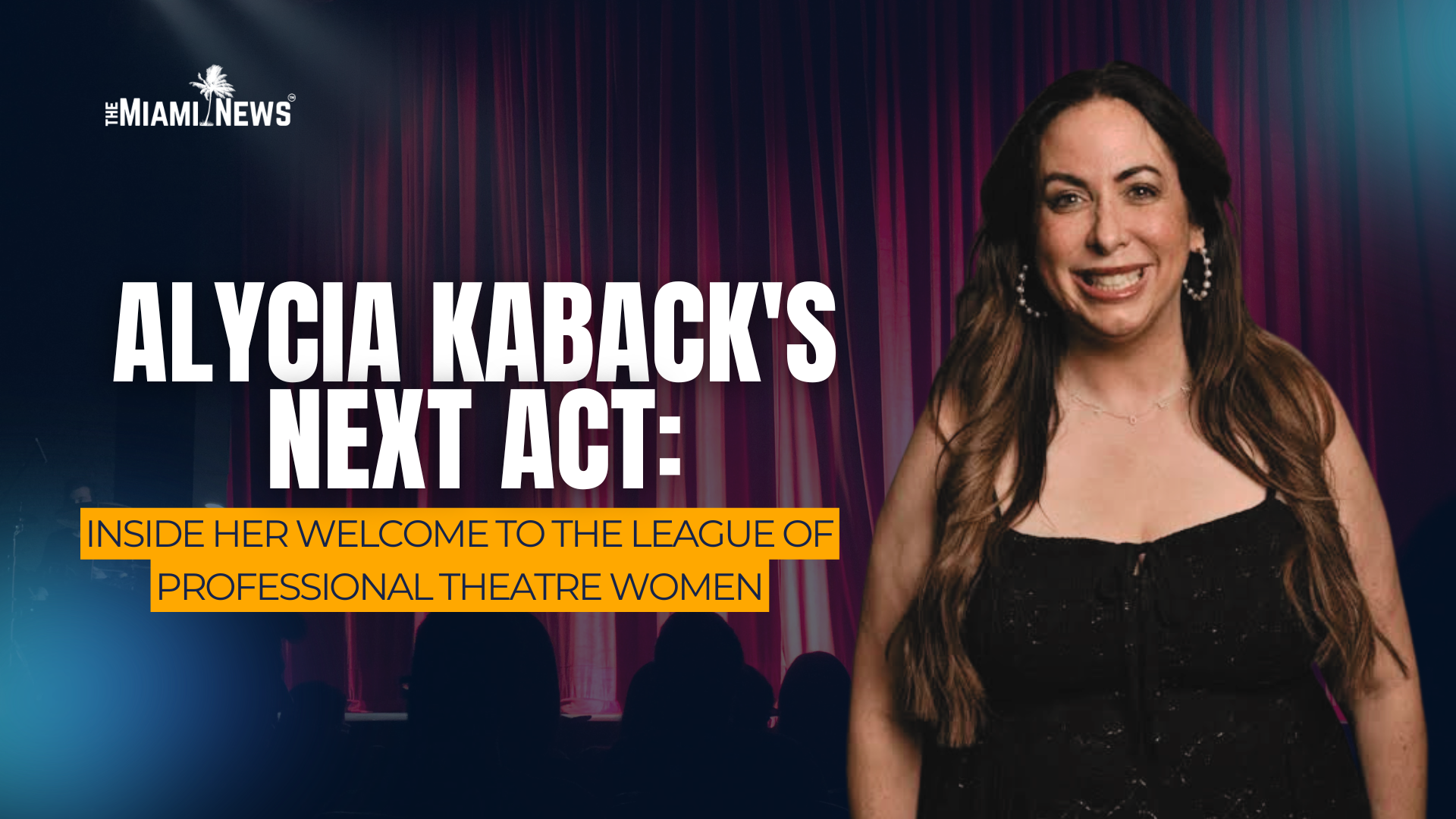
For the VIP Ignite co-founder, a September welcome letter connects a personal journey through entertainment with a movement that has spent decades expanding women’s place in professional theatre.
Theatre understands the significance of an entrance. A door opens, someone steps forward, and the possibilities of the scene change. Sometimes the entrance happens on paper.
For Alycia Kaback, a letter dated September 10, 2026 offers just such a moment: a welcome to the League of Professional Theatre Women, an organization whose history reaches into the long campaign to give women greater influence over the stories audiences see.
“We are thrilled to welcome you to our vibrant community of creative and accomplished theatre professionals,” reads the letter signed by Elisabeth Ruthman, the League’s vice president of membership.
Its language is warm, its instructions practical. There are orientations to attend, committees to consider, colleagues to meet. Beneath those details lies the possibility that makes this particular welcome compelling: a woman who has built a career around introductions now has a new community in which to make them.
For VIP Ignite’s co-founder, the occasion brings together two persistent themes in her professional life: finding a place in entertainment, and helping others imagine a place for themselves.
San Diego, 1981
To appreciate the company she has been welcomed into, it helps to rewind.
At an American Theatre Association conference in San Diego in 1981, a group of women began discussing a problem. Opportunities for female playwrights and directors were scarce. Women had helped establish the regional theatre movement. Even so, they remained poorly represented in its artistic leadership. Broadway offered similarly limited opportunities beyond performing. The League’s own history records a striking detail about that era: no woman had ever won a Tony Award for directing.
Julia Miles, then associate director of New York’s American Place Theatre, became the League’s founding member and first chair. Her aim was to bring commercial producers into contact with women creating work in nonprofit theatre. As she put it: “so that we could get them some work.” The League incorporated in 1986, giving an enduring organizational structure to the effort. It now counts nearly 500 members across virtually every theatrical discipline.
There is something wonderfully revealing about Miles’s phrasing. It brings the conversation down to the working life of an artist. The script someone reads. The director someone considers. The production someone agrees to support. Behind every celebrated opening night stand decisions of that kind. Change the people participating in those decisions, and the theatre’s possibilities expand.
From Coral Springs to the Front Row
Kaback’s own beginnings give that argument a personal resonance. Her published biography describes an early job waiting tables at Planet Hollywood in Coral Springs, Florida. A decade in real estate and mortgage finance followed. Entertainment was a world she had to learn to enter. The distance between wanting a creative life and understanding how to build one became part of her story.
“I went from knowing nobody in this industry to sitting in the front row at the Tony Awards,” she recalls on her website.
The sentence has the compression of a movie montage. The years disappear between its opening and closing images. What remains is the change in perspective. A person who once saw an industry from the outside learns its language. Then she develops relationships, and begins to participate in its work. It is a journey that gives the subject of access an immediate, human scale.
A Tony-Winning Credit
Her professional profile records that she helped bring Vanya and Sonia and Masha and Spike, starring Sigourney Weaver, to Broadway in 2013. The production won that year’s Tony Award for Best Play. It is a concrete connection to the theatrical world this new chapter brings further into focus.
By 2017, her aptitude for introductions had caught the attention of Entrepreneur. Writer Lucinda Honeycutt, describing a meeting with Kaback, singled out her “natural energy, enthusiasm and ability to bounce back from rejection.” It was an observation about temperament as much as business. Specifically, the capacity to keep approaching people, even after an encounter had failed to produce the hoped-for result.
That observation sits comfortably beside the League’s founding philosophy. Introductions are a craft. They require attention to what another person is making, what a project needs, and where two ambitions might meet. For an entrepreneur whose work revolves around bringing people together, the organization offers a familiar principle on a broader theatrical canvas.
VIP Ignite, founded in 2006, reaches its twentieth anniversary in 2026. Meanwhile, across that period, Kaback’s work has connected talent development with mentorship and industry relationships. Her book Finding Fame extends that public conversation about navigating entertainment. Read against that history, the League’s welcome suggests another opportunity to keep learning while contributing experience accumulated over two decades.
The Vocabulary of a Room
Every room in entertainment has its own vocabulary. What is being developed. Who is available. Which idea needs support, and where an introduction might lead. Learning to take part in those exchanges is a form of professional education.
For Kaback, the League offers an additional setting for that education, with colleagues whose specialties reach beyond her own. The potential value lies in the detail: a perspective on a script, a lesson from a difficult production, a conversation that changes how an emerging artist is advised. Such exchanges give a network its working life.
The organization offers several ways for that exchange to happen. Julia’s Reading Room, founded by Gail Kriegel and Maxine Kern and named for Miles, gives members a forum to present works in progress. Playwrights, librettists, directors, actors and producers are among those it serves.
A reading has its own particular electricity. The pages are still changeable. A line can find its rhythm in an actor’s voice; a scene can reveal a weakness its author could not hear alone. For someone whose career includes developing talent and supporting creative work, such a setting offers the possibility of encountering a project while its future is still being imagined.
Keeping the Record
The League also looks backward with purpose. Its Oral History Project, conceived and founded by Betty Corwin, documents women’s contributions in partnership with the New York Public Library for the Performing Arts. Featured interviews include Lynn Nottage, Tyne Daly, Laura Linney, Judith Light and Bebe Neuwirth. Their experiences become part of a record available beyond a single performance or season.
Preserving those accounts carries a significance of its own. A younger artist can encounter the thinking behind a career. That includes the choices a program biography has little space to explain. An established professional can discover another way of approaching familiar challenges. Experience becomes something colleagues can study, question, and carry forward.
What the Letter Opens
The welcome letter places Kaback within reach of this broader conversation. It outlines membership activation, a professional directory, networking events and seminars. Furthermore, it encourages committee work and discipline roundtables, where connections deepen through shared activity.
“Many of our members have built lasting friendships and valuable professional connections through committee work,” the letter notes.
The letterhead itself offers a glimpse of that breadth. Its advisory council co-chairs are listed as Theresa Rebeck and Daryl Roth, alongside a roster of board members and past presidents. Read together, those names place the welcome inside an institution sustained by many careers, disciplines and generations. Kaback is being invited to add her participation to that continuing effort.
That invitation may be the most consequential element for her. The significance, viewed through her career, runs in both directions. She has the opportunity to encounter women whose experience can extend her own perspective. She can also contribute the practical knowledge of an entrepreneur who has spent years helping people approach an unfamiliar industry.
An Argument for Second Acts
For the VIP Ignite community, there is a useful example here. Leadership can include continuing to seek colleagues, continuing to listen, and entering a room with something to learn. Even after decades in business, a new introduction can begin a new period of professional growth. The possibility remains open.
Moreover, there is particular resonance here for women imagining a second act of their own. A professional community gives ambition a social dimension. There are people to discuss a project with, ask a specific question, or share a difficult decision. The private wish to make something can begin to acquire the practical shape of a working life.
The League’s mission gives that individual story a collective setting. Its stated purpose is to increase the visibility of and promote opportunities for women in all aspects of the professional theatre. Those ambitions depend on successive generations choosing to participate. An organization with decades of history continues through the work its members undertake now.
Kaback’s September letter arrives at that intersection of inheritance and possibility. Behind it stands a history of women organizing, introducing, preserving and producing. Ahead, the work continues. Ahead are conversations whose outcomes have yet to be determined. For someone whose work has repeatedly returned to the power of human connection, that is fertile territory.
The next scene is still unwritten. There are colleagues to meet, ideas to exchange, and work to discover. Alycia Kaback has received her welcome. The interesting part will be what she helps make happen once the conversation begins.