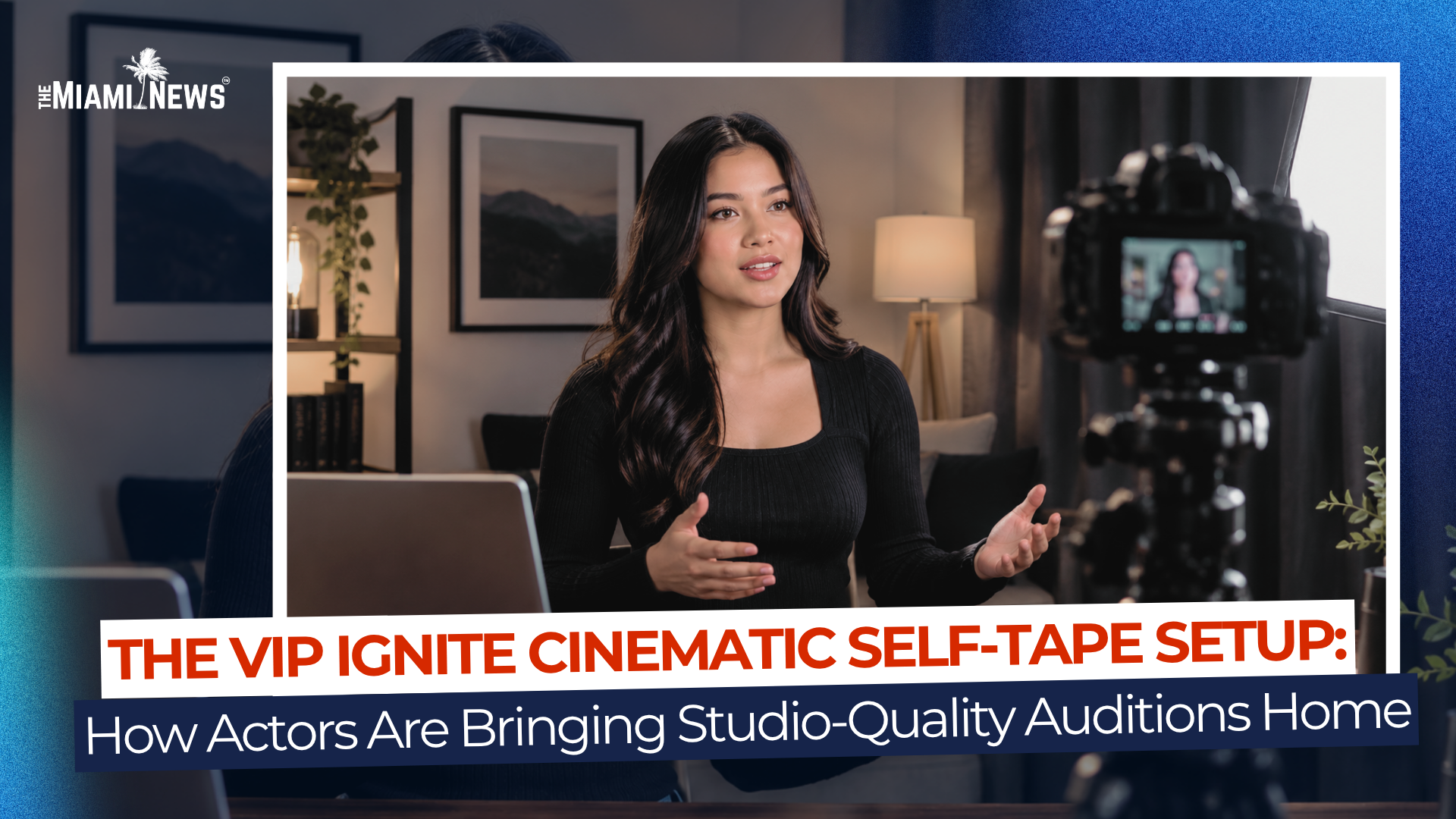
As self-taped auditions become a fixture of modern casting, VIP Ignite is teaching performers how strategic lighting, camera placement and a carefully chosen background can turn an ordinary room into a professional audition space.
The audition room has changed.
For generations, actors seeking a role expected to walk into a casting office, stand beneath professional lights and perform in front of casting directors. Today, an increasingly important part of that first impression is being created somewhere else entirely: bedrooms, living rooms, home offices and improvised studios, with a smartphone or camera recording the performance.
That shift has placed a new responsibility on actors. Performing well remains paramount, but performers must also understand how to present that performance effectively on camera.
VIP Ignite, the talent-development and entertainment-industry platform, is encouraging actors to approach their self-tape environment with the same intentionality they bring to their performance. Its recommended cinematic setup focuses on four deceptively simple ingredients: a strong primary light, controlled shadows, a subtle hair or rim light and a clean, darker backdrop.
The underlying principle is straightforward: the equipment should never become more noticeable than the actor.
The Self-Tape Is Now Part of the Performance
A camera sees a room differently than the human eye.
Overhead household lighting can create shadows beneath the eyes. A performer standing directly against a wall can appear visually flat. Mixed daylight and artificial illumination can produce inconsistent skin tones. A cluttered background can compete for attention at precisely the moment an actor wants a casting professional focused on facial expressions and dialogue.
The solution does not necessarily require an expensive studio.
A smartphone, stable tripod, large LED or ring light and inexpensive piece of dark fabric can substantially change the appearance of a self-tape when those elements are positioned correctly.
VIP Ignite’s philosophy can be summarized in three words: placement over price.
An 18-inch dimmable ring light, for example, provides a relatively large source of illumination and allows actors to control brightness. But rather than automatically positioning the light directly in front of the face—the familiar configuration used for social-media videos—the cinematic approach moves the primary light approximately 30 to 45 degrees away from the camera.
Positioned slightly above eye level and angled downward, the light can illuminate the eyes and expressions while retaining a gentle shadow on the opposite side of the face.
That shadow matters.
Perfectly flat illumination can remove much of the natural dimension cameras use to define facial features. Conversely, excessively dramatic shadows can obscure the very expressions casting professionals need to evaluate.
The objective lies between the two: clarity with dimension.
Creating Separation From the Background
One of the most effective additions to a home audition setup happens behind the performer.
A small LED positioned behind and off to one side can function as a hair light, rim light or back light. Rather than flooding the actor with brightness, it creates a restrained highlight around the hair or shoulders.
That narrow edge of illumination separates the performer visually from the background and can give an otherwise simple image considerably greater depth.
Subtlety is crucial. If viewers immediately notice a bright lamp shining behind the actor, the effect has probably gone too far.
The background itself deserves similar restraint.
VIP Ignite recommends dark brown, charcoal, dark gray or another neutral backdrop with little or no distracting pattern. Professional photography backdrops work, but actors working with limited budgets can achieve a similar principle with dark textured fabric purchased from a fabric store.
The actor should ideally stand some distance in front of it rather than pressing directly against the backdrop. The additional space creates physical and visual depth while giving the rim light room to do its work.
For casting purposes, simplicity is an advantage. The background’s job is not to establish a character or demonstrate interior-design taste. Its job is to disappear.
Why More Light Isn’t Necessarily Better
Perhaps the easiest mistake in home video production is assuming brightness equals quality.
It doesn’t.
An excessively powerful key light can wash out skin, create bright patches across the forehead and cheeks and eliminate facial detail. VIP Ignite instead recommends beginning with a lower brightness setting and gradually increasing illumination while monitoring the image through the camera that will actually record the audition.
Actors should look for clear eyes, natural skin tones and visible facial detail without blown-out highlights.
Color temperature is equally important.
Modern LED lights often allow users to move between warmer and cooler illumination. Problems emerge when several sources with dramatically different color temperatures illuminate the same scene: one side of a face can appear warm or orange while another takes on a cooler blue cast.
Turning off unnecessary household lights and controlling daylight from windows can help. When multiple dedicated lights are being used, their color temperatures should generally be matched or intentionally balanced.
A neutral to slightly warm appearance may work well for many skin tones and environments, but there is no universal setting. The camera—not simply the actor’s reflection in a mirror—should determine the final adjustment.
The 15-Second Test That Can Save an Audition
Before beginning a full take, actors can perform one of the simplest quality-control measures available: record 10 to 15 seconds and watch it back.
The distinction between monitoring a live image and reviewing an actual recording is important. The test reveals how the camera is handling exposure, skin tone, shadows and background separation.
Both eyes should remain clearly visible. Highlights should retain detail. Shadows should create shape without obscuring expression. The hair light should provide separation without drawing attention to itself.
Then there are the details that have nothing to do with lighting: Is the camera at eye level? Is the frame appropriate for the casting instructions? Is something distracting visible in the background? Is the phone or camera completely stable?
These checks require less than a minute. Re-recording an otherwise excellent performance because of a preventable technical problem can require considerably longer.
From a Smartphone to a Home Audition Studio
The accessibility of modern camera technology has made sophisticated-looking self-tapes possible without sophisticated budgets.
A starter configuration can consist of a smartphone, tripod, large ring or LED light and roughly $20 to $30 worth of dark textured fabric. The performer can then build outward, adding a bi-color rim light, backdrop stand, light-control grid or modifier and eventually a dedicated camera if the investment makes sense.
But purchasing everything at once misses the larger lesson.
A modest light placed intelligently can produce a better result than multiple expensive lights positioned poorly.
The same principle applies to cameras. Today’s smartphones can produce highly detailed video, but resolution alone cannot compensate for an unstable frame, distracting room or poorly illuminated face.
For performers accustomed to concentrating exclusively on acting technique, the technical requirements of self-taping can initially feel like another profession entirely. Yet the fundamentals are relatively compact: control the room, simplify the background, stabilize the camera, shape the primary light and create enough separation to keep the performer visually distinct.
Once the setup is established, it can largely remain established.
Technology Should Disappear
The most successful self-tape setup may ultimately be the one nobody notices.
Casting professionals should not finish an audition thinking about the actor’s ring light, backdrop or rim light. Those elements exist to remove visual obstacles between the performance and the person evaluating it.
That distinction is particularly important as actors gain access to increasingly sophisticated cameras, lights and editing tools. A self-tape can be polished without becoming a short film. Technical presentation should support the audition rather than overwhelm it.
For VIP Ignite, that produces a simple hierarchy: performance first, presentation in service of performance.
Professional-looking self-tapes do not necessarily require professional studios. They require control—of light, background, framing and the small visual decisions that influence how a camera sees a face.
The actor remains the subject.
Everything else should quietly help the viewer see them.
VIP Ignite: Light Better. Audition Stronger.