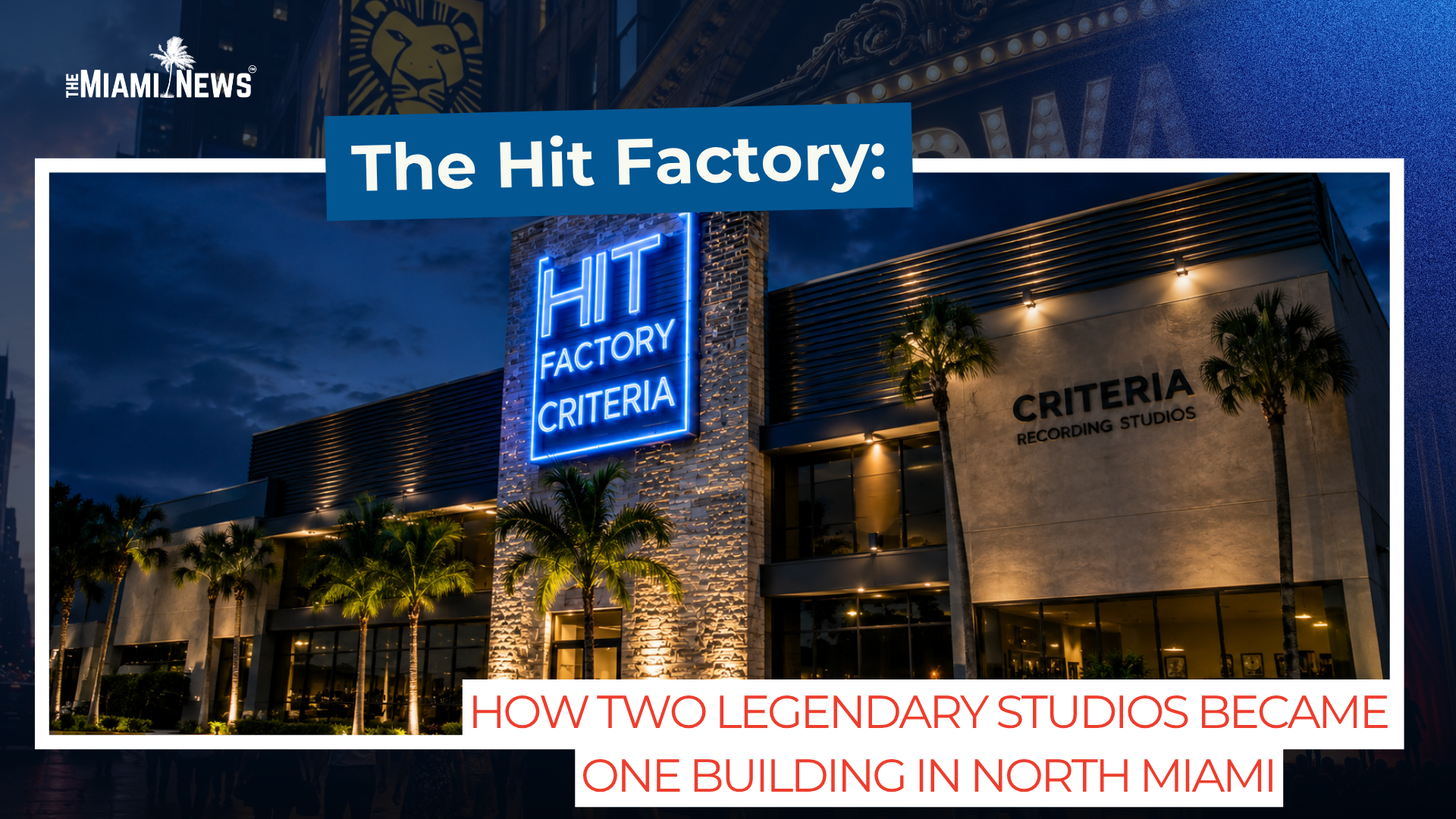
It began in 1969 as a small room rented by a songwriter who wanted somewhere to work. Over the next half-century, The Hit Factory name would move six times, cross an ocean, and end up on a low-slung building in North Miami that was already one of the most storied recording studios in America. This is how it happened.
Drive north on West Dixie Highway, turn at 149th Street, and you will pass it without noticing: a plain, single-story building set back behind a parking lot, the kind of structure that could house a dentist’s office or a printing company.
Inside that building, Eric Clapton recorded “Layla.” The Eagles cut Hotel California. The Bee Gees rewrote the sound of the late 1970s. Aretha Franklin sang there. So did Bob Marley. Fleetwood Mac worked on Rumours there. Later, Michael Jackson, Jay-Z and Lil Wayne all made records in the same rooms.
For eighteen years, the sign out front read The Hit Factory Criteria Miami — the meeting point of two separate American recording dynasties, one born in Manhattan and one born in North Miami, eleven years apart.
1969: A Songwriter Needs a Room
The Hit Factory started with Jerry Ragovoy, and it started small.
Ragovoy was not a studio magnate. He was a songwriter and producer — the man behind “Piece of My Heart” and “Time Is on My Side” — and in 1969 he opened a modest facility on Seventh Avenue in Manhattan mainly so that he would have a reliable place to work. The name was a piece of plainspoken ambition. In 1972 the operation moved to 353 West 48th Street, into the dense grid of music-business buildings clustered around Times Square.
It might have stayed a boutique operation. Instead, on March 6, 1975, it was bought by a man who understood exactly what the name could become.
Ed Germano and the Making of an Institution
Edward Germano was a singer and record producer who had been a principal owner of Record Plant Studios in New York, one of the defining rooms of the era. When he purchased The Hit Factory from Ragovoy, he did not simply take over a lease. He redesigned the studios, and he designed the logo that the company still uses today.
What followed was two decades of steady, deliberate expansion — and a run of records that is difficult to overstate.
At 48th Street, John Lennon and Yoko Ono recorded Double Fantasy between August and October of 1980 — in secret, under a false name. The Rolling Stones made Emotional Rescue. Meat Loaf’s Bat Out of Hell, Talking Heads’ Fear of Music and Hall & Oates’ Voices all passed through.
In 1981 the company moved to 237 West 54th Street, where Germano designed five rooms and installed the first mastering suite for engineer Herb Powers Jr. Bruce Springsteen recorded Born in the U.S.A. there. Years later, in the same complex, The Notorious B.I.G. made Ready to Die.
In 1987 came a second Manhattan facility on West 42nd Street, housing two recording rooms and three mastering suites. From 1989 to 1993 the Germanos ran The Hit Factory London in partnership with Sony Music UK, in the old CBS building on Whitfield Street in Soho.
Then, in 1993, they built the room that defined the peak of the analog era.
The Hit Factory at 421 West 54th Street
The new headquarters occupied roughly 100,000 square feet: seven recording and mixing studios, five mastering studios, and five private writing and production suites. Studio 1 was built to hold an orchestra of up to 140 musicians — a scale almost nobody was building for anymore.
The list of what came out of that building reads like a syllabus. Michael Jackson’s HIStory. Mariah Carey’s Daydream and Butterfly. Whitney Houston’s work for The Bodyguard. Lauryn Hill’s The Miseducation of Lauryn Hill. Madonna’s Ray of Light. U2’s Pop. Celine Dion’s Falling Into You. Natalie Cole’s Unforgettable… With Love. TLC’s CrazySexyCool.
Across its history, work done under The Hit Factory banner has been associated with 27 RIAA Diamond certifications, ten Grammy wins for Album of the Year, and three Academy Awards for Best Original Song — among them “My Heart Will Go On.”
What made the building unusual was not only its size but its range. In the same era that Studio 1 was booking orchestras, the smaller rooms were hosting the artists who were dismantling the idea that you needed an orchestra at all. The Notorious B.I.G. recorded Life After Death under the Hit Factory banner. TLC cut CrazySexyCool. A generation of New York producers worked in rooms designed for string sections and used them for drum machines instead.
That was the last moment when a single building could plausibly claim to sit at the center of American popular music. Within a decade, the economics that supported it were gone: budgets collapsed, home rigs got good, and the labels that had reliably booked weeks at a time stopped booking at all.
By 2002, the company had consolidated its New York operations at 421 West 54th. By then, though, its most interesting move had already happened — and it had happened 1,200 miles south.
North Miami, 1958: The Other Half of the Story
Criteria did not need The Hit Factory to make it famous. It had been famous for forty years.
Mack Emerman, a Miami trumpet player with an ear for sound, opened Criteria in 1958 in a 30-by-60-foot building at 149th Street and West Dixie Highway, designed by architect Charles C. Reed Jr. He started with jazz dates and commercial work. In 1965 he added Studio A, built to hold a 72-piece orchestra — an extraordinary bet for a young studio in a city that was not yet a music capital.
That same year, James Brown cut “I Got You (I Feel Good)” at Criteria. It became the studio’s first gold record.
The bet paid off spectacularly. Atlantic Records executives Ahmet Ertegun and Jerry Wexler began sending artists south, and producer Arif Mardin made the studio a second home. Criteria picked up a nickname that stuck: Atlantic Studios South. Aretha Franklin recorded there. So did Brook Benton, the Allman Brothers Band, and Eric Clapton — who, with Derek and the Dominos, made Layla and Other Assorted Love Songs in the building.
The Eagles worked on Hotel California there. Fleetwood Mac tracked portions of Rumours. Black Sabbath made Technical Ecstasy. Bob Marley recorded there.
The Tom Dowd Story
If one session explains what Criteria was, it is the making of Layla in August of 1970.
Tom Dowd — the Atlantic engineer and producer who had already shaped records by Ray Charles, John Coltrane and Aretha Franklin — was producing Eric Clapton’s new band, Derek and the Dominos, at Criteria, with Miami brothers Ron and Howard Albert engineering. Dowd had also been working with a young southern group called the Allman Brothers Band, and when they came through town he took Clapton to see them play.
Duane Allman ended up at Criteria. The two guitarists met in the studio, played for most of a day and a night, and Allman stayed for the record. The seven-note figure that opens “Layla” came out of that meeting. The full story of that night is here.
It is the kind of thing that only happens in a building where a lot of different people are working at once, in a city far enough from the industry’s centers of gravity that artists relax. The Albert brothers’ work at Criteria became so identifiable that the studio’s sound was, for a stretch of the 1970s, a recognizable commodity in its own right.
And in 1975 the Bee Gees moved to Miami. That story is told in full here.
Six Number Ones in Six Months
What the Bee Gees did at Criteria with Arif Mardin and engineer Karl Richardson is one of the most concentrated runs of commercial dominance in the history of popular music. In the first six months of 1978 alone, six songs they wrote or performed reached No. 1 on the Billboard Hot 100 — breaking a record previously held by the Beatles.
The disco era was, for a stretch, being manufactured in North Miami.
Criteria kept building. In 1981, designer John Storyk created Studio E, a room with soaring peaked ceilings that became one of the most requested spaces in the South. John Mellencamp cut “Jack & Diane” in it.
Then the industry contracted. The 1980s were hard on independent studios, and Criteria was not spared. In 1991, after thirty-three years, Mack Emerman sold the studio he had built to Joel Levy.
January 12, 1999
Eight years later, after roughly two months of negotiation with Levy, The Hit Factory closed on the purchase of Criteria Recording Studios.
The Germanos did not rush. They waited six months, then began a phased renovation that ran until March 2000 — rebuilding a nearly 30,000-square-foot facility into six full studios plus a scoring room, a mastering suite, digital editing rooms and pre-production spaces. Designers David Bell and Neil Grant reworked the acoustic isolation, the electrical systems and the HVAC, and finished the rooms in African slate and Italian porcelain. A new all-digital Studio F was added, built around a 120-channel Sony OXF-R3 console.
Troy Germano, Ed’s son, described the goal as bringing Criteria up to the standard they had set in New York while protecting whatever it was that had made the place work in the first place — a balancing act every renovation of a historic studio has to attempt and most of them fail.
Emerman, for his part, gave the transition his blessing publicly, saying he trusted the Germanos with the building more than anyone else he could think of.
It reopened as The Hit Factory Criteria Miami: two lineages, one address.
The Miami Era
The second life of the building belonged largely to hip-hop and R&B.
Michael Jackson recorded Invincible there. Jay-Z made The Black Album. Timbaland worked there; so did Jennifer Lopez. Beginning in 2005, Lil Wayne effectively took up residence in Studio E for a multi-year stretch, and the work that came out of it fed directly into the run that made him the biggest rapper in America.
For a period in the early 2000s, Troy Germano was overseeing sixteen recording rooms and six mastering suites across New York and Florida — very likely the largest independent studio operation in the country.
It did not last, and the reasons were mostly not musical.
What Happened to the Buildings
Ed Germano died in 2003.
Two years later, the 421 West 54th Street headquarters closed. The popular explanation — that digital recording had killed the big studio — is only partly right; the company has said the building was sold for estate planning reasons. Manhattan real estate did the rest. The site was redeveloped into residences, which is what happened to most of the great New York rooms.
The Germanos sold the Miami facility in 2012, keeping the Hit Factory name and trademark. In 2017 the North Miami studio went back to the name it started with: Criteria Studios.
The Hit Factory itself did not disappear. In 2008 Troy Germano opened a new facility at 676 Broadway in Noho, operating for years as Germano Studios; in 2023 he redesignated it The Hit Factory, and it runs today as the only studio in the world carrying that name — two rooms built around SSL Duality Delta consoles, a fraction of the old footprint, and a client list that has included the Rolling Stones’ Hackney Diamonds.
What Is Still There
Criteria is still open. That sentence is not a small thing: almost none of its contemporaries are.
The building now holds six studios, each with its own secure entrance — an architectural admission of how the business changed. There are no staff engineers anymore. Trevor Fletcher, the studio’s vice president and unofficial historian, keeps a roster of freelancers who can be called in by genre, and a team focused mostly on maintaining the rooms and the equipment.
The social texture is gone too. The era when artists from three different sessions would end up shooting baskets together in the parking lot is over.
What remains is the rooms, and the argument for them. Asked why anyone still needs a building like this when a laptop will do, Fletcher put it about as well as it can be put: “You can also do heart surgery with a Ginsu knife. But should you?”
The studio counts more than 750 gold and platinum awards across every genre, and says music made in the building has drawn well over 400 billion streams since 2006. Fletcher maintains a playlist of songs recorded there; it runs to hundreds of tracks and roughly thirty hours.
Two Names, One Building
The Hit Factory and Criteria came from different places and different decades. One was a New York songwriter’s workroom that a producer turned into an institution. The other was a Miami jazz studio that talked Atlantic Records into flying its stars south.
For eighteen years they shared a name and an address in North Miami, and during that time the building did what it had always done: it kept making records that outlived the businesses around them.
The studios are quieter now. The parking lot is just a parking lot. But the room where Clapton played “Layla,” where the Bee Gees built 1978, where Lil Wayne moved in for three years — that room is still standing on 149th Street, and it is still working.
Which, in the recording business, counts as a miracle.
More from The Miami News: Music coverage · BTS Walks Away From the Grammys and Reopens a Bigger Debate About Who Gets to Be “Global”